Delude R L, Savedra R, Zhao H, Thieringer R, Yamamoto S, Fenton M J, Golenbock D T
Evans Department of Clinical Research and Medicine, Boston University Medical Center Hospital, MA 02118, USA.
Proc Natl Acad Sci U S A. 1995 Sep 26;92(20):9288-92. doi: 10.1073/pnas.92.20.9288.
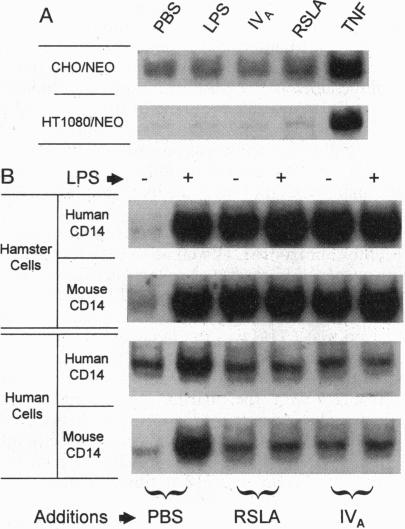
Binding of the lipid A portion of bacterial lipopolysaccharide (LPS) to leukocyte CD14 activates phagocytes and initiates the septic shock syndrome. Two lipid A analogs, lipid IVA and Rhodobacter sphaeroides lipid A (RSLA), have been described as LPS-receptor antagonists when tested with human phagocytes. In contrast, lipid IVA activated murine phagocytes, whereas RSLA was an LPS antagonist. Thus, these compounds displayed a species-specific pharmacology. To determine whether the species specificity of these LPS antagonists occurred as a result of interactions with CD14, the effects of lipid IVA and RSLA were examined by using human, mouse, and hamster cell lines transfected with murine or human CD14 cDNA expression vectors. These transfectants displayed sensitivities to lipid IVA and RSLA that reflected the sensitivities of macrophages of similar genotype (species) and were independent of the source of CD14 cDNA. For example, hamster macrophages and hamster fibroblasts transfected with either mouse or human-derived CD14 cDNA responded to lipid IVA and RSLA as LPS mimetics. Similarly, lipid IVA and RSLA acted as LPS antagonists in human phagocytes and human fibrosarcoma cells transfected with either mouse or human-derived CD14 cDNA. Therefore, the target of these LPS antagonists, which is encoded in the genomes of these cells, is distinct from CD14. Although the expression of CD14 is required for macrophage-like sensitivity to LPS, CD14 cannot discriminate between the lipid A moieties of these agents. We hypothesize that the target of the LPS antagonists is a lipid A recognition protein which functions as a signaling receptor that is triggered after interaction with CD14-bound LPS.
细菌脂多糖(LPS)的脂质A部分与白细胞CD14结合会激活吞噬细胞并引发败血性休克综合征。两种脂质A类似物,脂质IVA和球形红杆菌脂质A(RSLA),在用人吞噬细胞进行测试时被描述为LPS受体拮抗剂。相比之下,脂质IVA激活了小鼠吞噬细胞,而RSLA是一种LPS拮抗剂。因此,这些化合物表现出物种特异性药理学特性。为了确定这些LPS拮抗剂的物种特异性是否是由于与CD14相互作用的结果,我们通过使用用小鼠或人CD14 cDNA表达载体转染的人、小鼠和仓鼠细胞系来研究脂质IVA和RSLA的作用。这些转染细胞对脂质IVA和RSLA的敏感性反映了相似基因型(物种)巨噬细胞的敏感性,并且与CD14 cDNA的来源无关。例如,用小鼠或人源CD14 cDNA转染的仓鼠巨噬细胞和仓鼠成纤维细胞对脂质IVA和RSLA的反应就如同它们是LPS模拟物一样。同样,脂质IVA和RSLA在用人源或鼠源CD14 cDNA转染的人吞噬细胞和人纤维肉瘤细胞中作为LPS拮抗剂起作用。因此,这些LPS拮抗剂的靶标,是由这些细胞的基因组编码的,与CD14不同。尽管巨噬细胞样细胞对LPS的敏感性需要CD14的表达,但CD14无法区分这些药剂的脂质A部分。我们推测LPS拮抗剂的靶标是一种脂质A识别蛋白,它作为一种信号受体,在与CD14结合的LPS相互作用后被触发。