Dimri G P, Lee X, Basile G, Acosta M, Scott G, Roskelley C, Medrano E E, Linskens M, Rubelj I, Pereira-Smith O
Department of Cell and Molecular Biology, Lawrence Berkeley Laboratory, University of California, Berkeley 94720, USA.
Proc Natl Acad Sci U S A. 1995 Sep 26;92(20):9363-7. doi: 10.1073/pnas.92.20.9363.
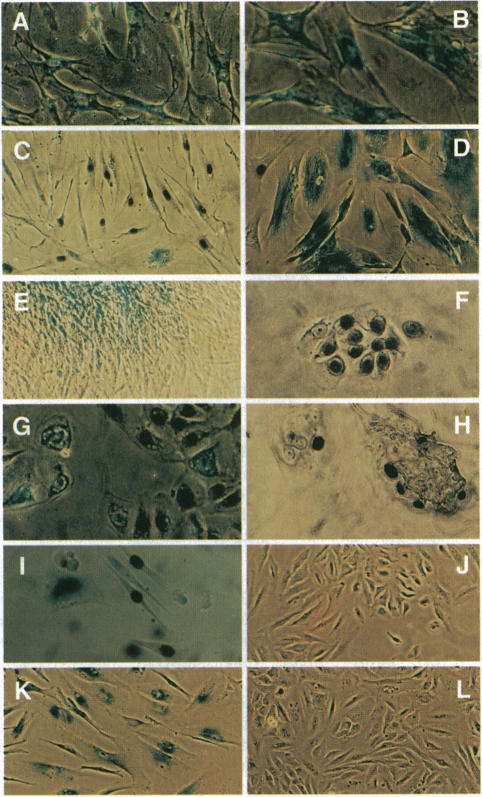
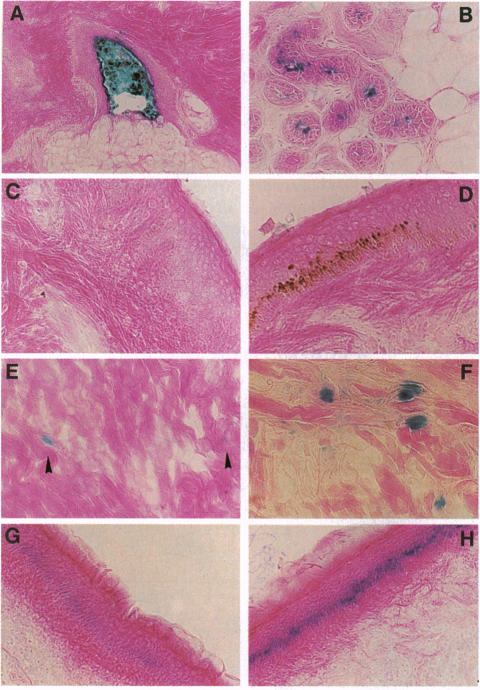
Normal somatic cells invariably enter a state of irreversibly arrested growth and altered function after a finite number of divisions. This process, termed replicative senescence, is thought to be a tumor-suppressive mechanism and an underlying cause of aging. There is ample evidence that escape from senescence, or immortality, is important for malignant transformation. By contrast, the role of replicative senescence in organismic aging is controversial. Studies on cells cultured from donors of different ages, genetic backgrounds, or species suggest that senescence occurs in vivo and that organismic lifespan and cell replicative lifespan are under common genetic control. However, senescent cells cannot be distinguished from quiescent or terminally differentiated cells in tissues. Thus, evidence that senescent cells exist and accumulate with age in vivo is lacking. We show that several human cells express a beta-galactosidase, histochemically detectable at pH 6, upon senescence in culture. This marker was expressed by senescent, but not presenescent, fibroblasts and keratinocytes but was absent from quiescent fibroblasts and terminally differentiated keratinocytes. It was also absent from immortal cells but was induced by genetic manipulations that reversed immortality. In skin samples from human donors of different age, there was an age-dependent increase in this marker in dermal fibroblasts and epidermal keratinocytes. This marker provides in situ evidence that senescent cells may exist and accumulate with age in vivo.
正常体细胞在有限次数的分裂后总会进入一种生长不可逆停滞且功能改变的状态。这一过程被称为复制性衰老,被认为是一种肿瘤抑制机制以及衰老的潜在原因。有充分证据表明,从衰老状态逃脱,即获得永生,对于恶性转化很重要。相比之下,复制性衰老在机体衰老中的作用存在争议。对来自不同年龄、遗传背景或物种供体的细胞进行培养的研究表明,衰老在体内会发生,并且机体寿命和细胞复制寿命受共同的遗传控制。然而,在组织中无法将衰老细胞与静止或终末分化细胞区分开来。因此,缺乏衰老细胞在体内随年龄存在并积累的证据。我们发现,几种人类细胞在培养过程中衰老时会表达一种β-半乳糖苷酶,在pH 6时可通过组织化学方法检测到。这种标记物在衰老的成纤维细胞和角质形成细胞中表达,而在衰老前的细胞中不表达,在静止的成纤维细胞和终末分化的角质形成细胞中也不存在。在永生细胞中也不存在,但可通过逆转永生的基因操作诱导产生。在来自不同年龄人类供体的皮肤样本中,真皮成纤维细胞和表皮角质形成细胞中这种标记物随年龄增加。这种标记物提供了原位证据,表明衰老细胞可能在体内随年龄存在并积累。