Sargiacomo M, Scherer P E, Tang Z, Kübler E, Song K S, Sanders M C, Lisanti M P
Whitehead Institute for Biomedical Research, Cambridge, MA 02142-1479, USA.
Proc Natl Acad Sci U S A. 1995 Sep 26;92(20):9407-11. doi: 10.1073/pnas.92.20.9407.
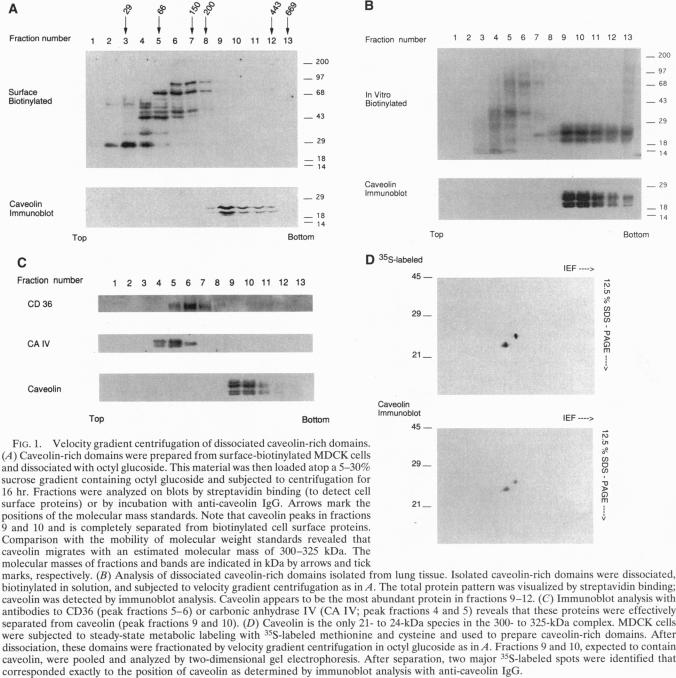
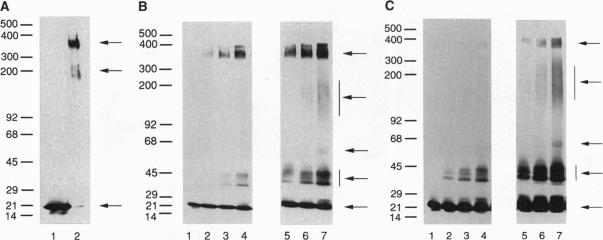
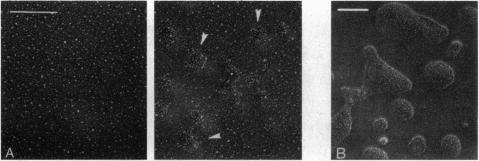
A 22-kDa protein, caveolin, is localized to the cytoplasmic surface of plasma membrane specializations called caveolae. We have proposed that caveolin may function as a scaffolding protein to organize and concentrate signaling molecules within caveolae. Here, we show that caveolin interacts with itself to form homooligomers. Electron microscopic visualization of these purified caveolin homooligomers demonstrates that they appear as individual spherical particles. By using recombinant expression of caveolin as a glutathione S-transferase fusion protein, we have defined a region of caveolin's cytoplasmic N-terminal domain that mediates these caveolin-caveolin interactions. We suggest that caveolin homooligomers may function to concentrate caveolin-interacting molecules within caveolae. In this regard, it may be useful to think of caveolin homooligomers as "fishing lures" with multiple "hooks" or attachment sites for caveolin-interacting molecules.
一种22千道尔顿的蛋白质,即小窝蛋白,定位于被称为小窝的质膜特化结构的细胞质表面。我们曾提出,小窝蛋白可能作为一种支架蛋白,在小窝内组织并聚集信号分子。在此,我们表明小窝蛋白可与自身相互作用形成同型寡聚体。对这些纯化的小窝蛋白同型寡聚体进行电子显微镜观察显示,它们呈现为单个球形颗粒。通过使用作为谷胱甘肽S - 转移酶融合蛋白的小窝蛋白的重组表达,我们确定了小窝蛋白细胞质N端结构域中介导这些小窝蛋白 - 小窝蛋白相互作用的区域。我们认为小窝蛋白同型寡聚体可能起到在小窝内聚集与小窝蛋白相互作用分子的作用。在这方面,将小窝蛋白同型寡聚体视为带有多个“钩子”或与小窝蛋白相互作用分子附着位点的“钓鱼诱饵”可能会有所帮助。