Vervoort R, Islam M R, Sly W, Chabas A, Wevers R, de Jong J, Liebaers I, Lissens W
Department of Medical Genetics, University Hospital, Vrije Universiteit Brussel, Belgium.
Am J Hum Genet. 1995 Oct;57(4):798-804.
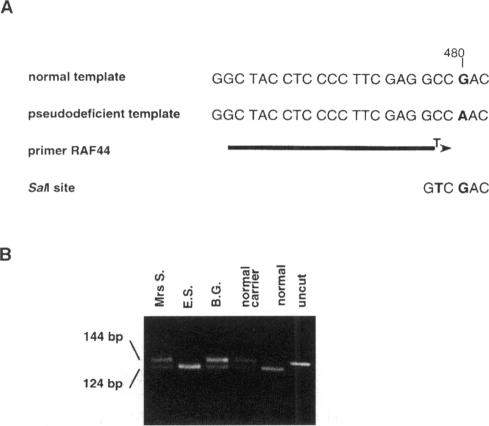
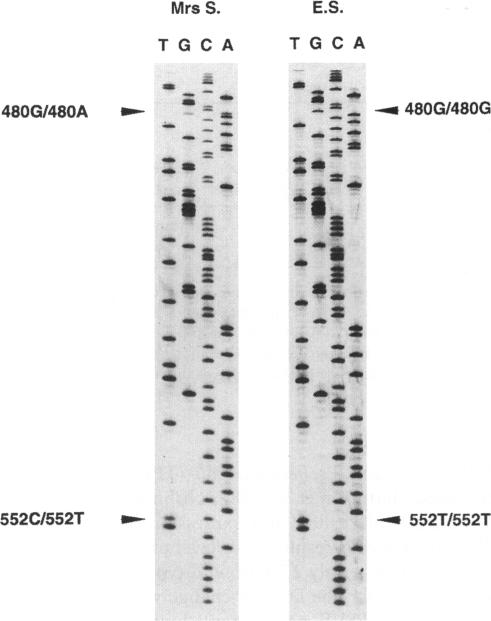
We present evidence that a 480G-->A transition in the coding region of the beta-glucuronidase gene, which results in an aspartic-acid-to-asparagine substitution at amino acid position 152 (D152N), produces a pseudodeficiency allele (GUSBp) that leads to greatly reduced levels of beta-glucuronidase activity without apparent deleterious consequences. The 480G-->A mutation was found initially in the pseudodeficient mother of a child with mucopolysaccharidosis VII (MPSVII), but it was not on her disease-causing allele, which carried the L176F mutation. The 480G-->A change was also present in an unrelated individual with another MPSVII allele who had unusually low beta-glucuronidase activity, but whose clinical symptoms were probably unrelated to beta-glucuronidase deficiency. This individual also had an R357X mutation, probably on his second allele. We screened 100 unrelated normal individuals for the 480G-->A mutation with a PCR method and detected one carrier. Reduced beta-glucuronidase activity following transfection of COS cells with the D152N cDNA supported the causal relationship between the D152N allele and pseudodeficiency. The mutation reduced the fraction of expressed enzyme that was secreted. Pulse-chase experiments indicated that the reduced activity in COS cells was due to accelerated intracellular turnover of the D152N enzyme. They also suggested that a potential glycosylation site created by the mutation is utilized in approximately 50% of the enzyme expressed.
我们提供的证据表明,β-葡萄糖醛酸酶基因编码区发生的480G→A转换,导致第152位氨基酸处天冬氨酸被天冬酰胺取代(D152N),产生了一个假缺陷等位基因(GUSBp),该等位基因导致β-葡萄糖醛酸酶活性水平大幅降低,但无明显有害后果。480G→A突变最初在一名患有黏多糖贮积症VII型(MPSVII)儿童的假缺陷母亲中发现,但不在其携带L176F突变的致病等位基因上。在另一名具有另一个MPSVII等位基因且β-葡萄糖醛酸酶活性异常低但临床症状可能与β-葡萄糖醛酸酶缺乏无关的无关个体中也存在480G→A变化。该个体可能在其第二个等位基因上还存在R357X突变。我们用PCR方法对100名无关正常个体进行了480G→A突变筛查,检测到一名携带者。用D152N cDNA转染COS细胞后β-葡萄糖醛酸酶活性降低,支持了D152N等位基因与假缺陷之间的因果关系。该突变降低了分泌的表达酶的比例。脉冲追踪实验表明,COS细胞中活性降低是由于D152N酶的细胞内周转加速所致。实验还表明,由该突变产生的一个潜在糖基化位点在大约50%表达的酶中被利用。