Cesnjaj M, Zheng L, Catt K J, Stojilkovic S S
Endocrinology and Reproduction Research Branch, National Institute of Child Health and Human Development, National Institutes of Health, Bethesda, Maryland 20892, USA.
Mol Biol Cell. 1995 Aug;6(8):1037-47. doi: 10.1091/mbc.6.8.1037.
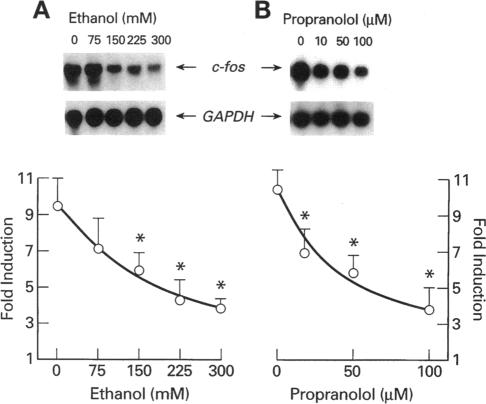
Stimulation of phospholipase D activity is frequently observed during agonist activation of Ca(2+)-mobilizing receptors, but the cellular functions of this signaling pathway are not well defined. Pituitary gonadotrophs express Ca(2+)-mobilizing receptors for gonadotropin-releasing hormone (GnRH) and endothelin (ET), activation of which stimulates luteinizing hormone secretion and transient expression of c-fos. In pituitary cells and alpha T3-1 gonadotrophs, GnRH action was associated with both initial and sustained diacylglycerol (DG) production, whereas ET-1 induced only a transient DG response. Also, phospholipase D activity, estimated by the production of phosphatidylethanol from phosphatidylcholine in the presence of ethanol, was stimulated by GnRH but not ET-1. Such formation of phosphatidylethanol at the expense of phosphatidic acid (PA) during GnRH-induced activation of phospholipase D significantly reduced the production of PA, DG, and cytidine diphosphate diacylglycerol. Inhibition of PA-phosphohydrolase activity by propranolol also decreased GnRH-induced DG production and, in contrast to ethanol, increased PA and cytidine diphosphate diacylglycerol levels. The fall in DG production caused by ethanol and propranolol was accompanied by inhibition of GnRH-induced c-fos expression, whereas agonist-induced luteinizing hormone release was not affected. In contrast to their inhibitory actions on GnRH-induced early gene expression, neither ethanol nor propranolol affected ET-1-induced c-fos expression, or GnRH- and ET-1-induced inositol trisphosphate/Ca2+ signaling. These findings demonstrate that phospholipase D participates in stimulus-transcription but not stimulus-secretion coupling, and indicate that DG is the primary signal for this action.
在动员钙离子的受体激动剂激活过程中,经常观察到磷脂酶D活性的刺激,但该信号通路的细胞功能尚未明确界定。垂体促性腺细胞表达促性腺激素释放激素(GnRH)和内皮素(ET)的动员钙离子的受体,其激活可刺激促黄体生成素分泌和c-fos的瞬时表达。在垂体细胞和αT3-1促性腺细胞中,GnRH的作用与初始和持续的二酰基甘油(DG)产生相关,而ET-1仅诱导瞬时的DG反应。此外,在乙醇存在下由磷脂酰胆碱产生磷脂酰乙醇来估计的磷脂酶D活性,受到GnRH刺激但不受ET-1刺激。在GnRH诱导的磷脂酶D激活过程中,以磷脂酸(PA)为代价形成磷脂酰乙醇显著降低了PA、DG和二磷酸胞苷二酰甘油的产生。普萘洛尔对PA-磷酸水解酶活性的抑制也降低了GnRH诱导的DG产生,并且与乙醇相反,增加了PA和二磷酸胞苷二酰甘油水平。乙醇和普萘洛尔引起的DG产生下降伴随着对GnRH诱导的c-fos表达的抑制,而激动剂诱导的促黄体生成素释放未受影响。与它们对GnRH诱导的早期基因表达的抑制作用相反,乙醇和普萘洛尔均未影响ET-1诱导的c-fos表达,或GnRH和ET-1诱导的肌醇三磷酸/Ca2+信号传导。这些发现表明磷脂酶D参与刺激-转录偶联而非刺激-分泌偶联,并表明DG是此作用的主要信号。