Shy C M, Degnan D, Fox D L, Mukerjee S, Hazucha M J, Boehlecke B A, Rothenbacher D, Briggs P M, Devlin R B, Wallace D D
University of North Carolina at Chapel Hill 27599, USA.
Environ Health Perspect. 1995 Jul-Aug;103(7-8):714-24. doi: 10.1289/ehp.95103714.
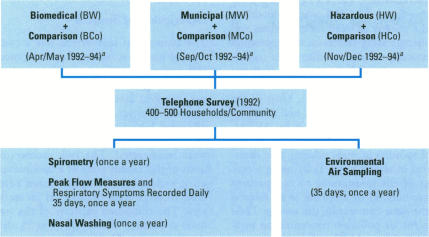
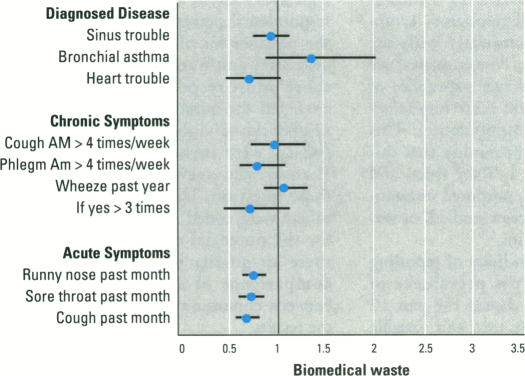
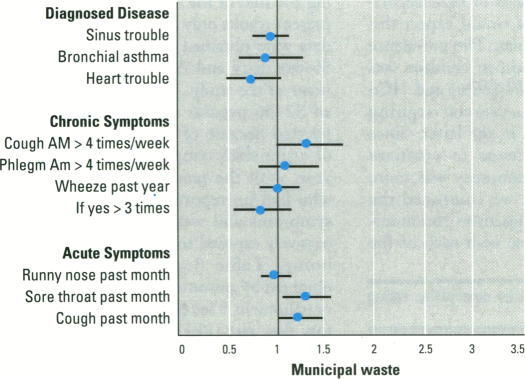
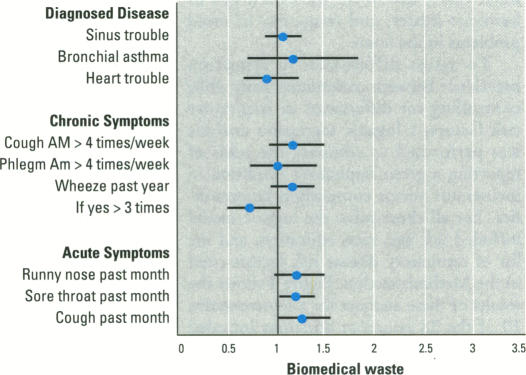
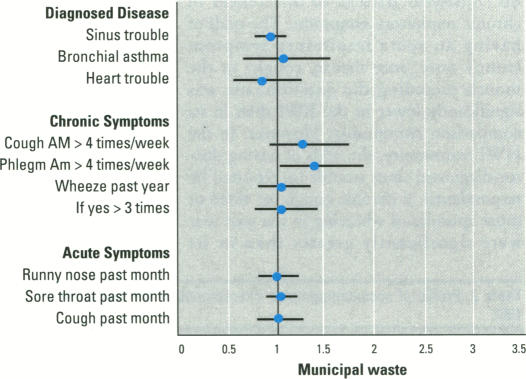
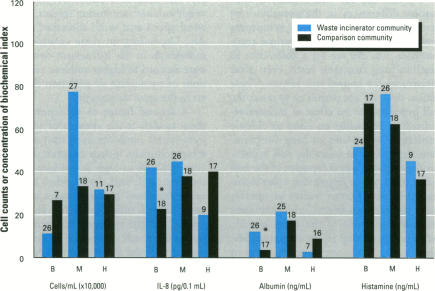
The purpose of the study presented here was to simultaneously measure air quality and respiratory function and symptoms in populations living in the neighborhood of waste incinerators and to estimate the contribution of incinerator emissions to the particulate air mass in these neighborhoods. We studied the residents of three communities having, respectively, a biomedical and a municipal incinerator, and a liquid hazardous waste-burning industrial furnace. We compared results with three matched-comparison communities. We did not detect differences in concentrations of particulate matter among any of the three pairs of study communities. Average fine particulate (PM2.5) concentrations measured for 35 days varied across study communities from 16 to 32 micrograms/m3. Within the same community, daily concentrations of fine particulates varied by as much as eightfold, from 10 to 80 micrograms/m3, and were nearly identical within each pair of communities. Direct measurements of air quality and estimates based on a chemical mass balance receptor model showed that incinerator emissions did not have a major or even a modest impact on routinely monitored air pollutants. A onetime baseline descriptive survey (n = 6963) did not reveal consistent community differences in the prevalence of chronic or acute respiratory symptoms between incinerator and comparison communities, nor did we see a difference in baseline lung function tests or in the average peak expiratory flow rate measured over a period of 35 days. Based on this analysis of the first year of our study, we conclude that we have no evidence to reject the null hypothesis of no acute or chronic respiratory effects associated with residence in any of the three incinerator communities.
本研究的目的是同时测量生活在垃圾焚烧炉附近人群的空气质量、呼吸功能和症状,并估计焚烧炉排放对这些社区空气中颗粒物总量的贡献。我们研究了分别拥有一座生物医学垃圾焚烧炉和一座城市垃圾焚烧炉以及一座液态危险废物焚烧工业炉的三个社区的居民。我们将结果与三个匹配的对照社区进行了比较。我们在三对研究社区中的任何一对中均未检测到颗粒物浓度的差异。在35天内测量的平均细颗粒物(PM2.5)浓度在各研究社区中有所不同,范围为16至32微克/立方米。在同一个社区内,细颗粒物的日浓度变化高达八倍,从10至80微克/立方米,并且在每对社区内几乎相同。空气质量的直接测量结果以及基于化学质量平衡受体模型的估计表明,焚烧炉排放对常规监测的空气污染物没有重大甚至适度的影响。一项一次性基线描述性调查(n = 6963)未揭示焚烧炉社区与对照社区之间在慢性或急性呼吸道症状患病率方面存在一致的社区差异,我们也未在基线肺功能测试或35天内测量的平均呼气峰值流速方面发现差异。基于我们研究第一年的这一分析,我们得出结论,我们没有证据拒绝与居住在三个焚烧炉社区中的任何一个相关的无急性或慢性呼吸影响的零假设。