Koch B, Kurriger G, Brand R A
Department of Orthopedic Surgery, University of Iowa, Iowa City 52242, USA.
J Anat. 1995 Oct;187 ( Pt 2)(Pt 2):353-9.
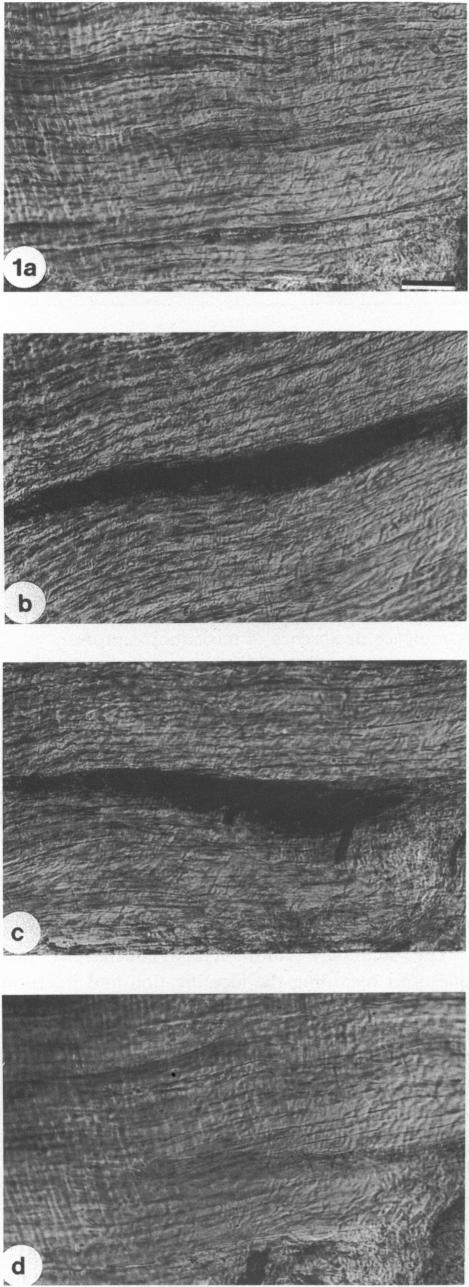
The identification and distribution of mechanoreceptors in the cranial cruciate ligament of the cat (analogous to the anterior cruciate ligament in other species) was studied histologically using a modified celloidin embedding technique to achieve serial sectioning of bone-ligament-bone preparations with gold chloride staining. We identified distinctive large elongated structures situated between the collagen bundles of the ligament (resembling endings described as Freeman and Wyke type III; also termed Golgi tendon receptors). These endings were found near the middle of the ligament well away from the bone-ligament junction. Axons seen entering only one end of each type III ending helped to confirm its neural basis. While we saw structures resembling types I and II endings (i.e. Ruffini and pacinian endings, respectively) in individual sections, serial sections failed to reveal convincing evidence of their existence. Such structures almost always appeared to be vascular in nature on adjacent sections, with vessels entering and exiting. We conclude that serial sections are critical to interpreting the presence or absence of mechanoreceptors.
利用改良的火棉胶包埋技术,对猫的颅交叉韧带(类似于其他物种的前交叉韧带)中的机械感受器进行组织学研究,以实现对骨-韧带-骨标本进行连续切片并进行氯化金染色。我们在韧带的胶原束之间发现了独特的大型细长结构(类似于Freeman和Wyke III型终末;也称为高尔基腱感受器)。这些终末位于韧带中部附近,远离骨-韧带交界处。仅见轴突进入每个III型终末的一端,这有助于证实其神经基础。虽然在个别切片中我们看到了类似于I型和II型终末的结构(即分别为鲁菲尼终末和环层小体终末),但连续切片未能揭示其存在的令人信服的证据。在相邻切片上,此类结构几乎总是呈现出血管的性质,有血管进出。我们得出结论,连续切片对于解释机械感受器的存在与否至关重要。