Volkmuth W D, Duke T, Austin R H, Cox E C
Department of Physics, Princeton University, NJ 08544-0708, USA.
Proc Natl Acad Sci U S A. 1995 Jul 18;92(15):6887-91. doi: 10.1073/pnas.92.15.6887.
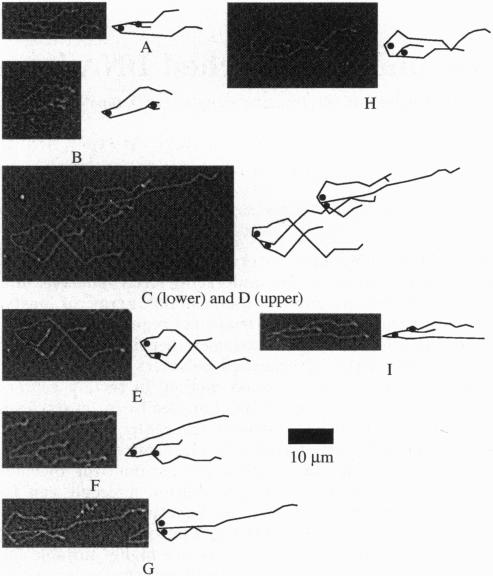
We have observed electrostatic trapping of tribranched DNA molecules undergoing electrophoresis in a microfabricated pseudo-two-dimensional array of posts. Trapping occurs in a unique transport regimen in which the electrophoretic mobility is extremely sensitive to polymer topology. The arrest of branched polymers is explained by considering their center-of-mass motion; in certain conformations, owing to the constraints imposed by the obstacles a molecule cannot advance without the center of mass first moving a short distance backwards. The depth of the resulting local potential well can be much greater than the thermal energy so that escape of an immobilized molecule can be extremely slow. We summarize the expected behavior of the mobility as a function of field strength and topology and point out that the microfabricated arrays are highly suitable for detecting an extremely small number of branched molecules in a very large population of linear molecules.
我们观察到在微制造的伪二维柱阵列中进行电泳的三叉 DNA 分子的静电捕获现象。捕获发生在一种独特的传输机制中,其中电泳迁移率对聚合物拓扑结构极为敏感。通过考虑支化聚合物的质心运动来解释其捕获现象;在某些构象中,由于障碍物施加的限制,分子在质心不先向后移动一小段距离的情况下就无法前进。由此产生的局部势阱深度可能远大于热能,以至于固定分子的逸出可能极其缓慢。我们总结了迁移率随场强和拓扑结构变化的预期行为,并指出微制造阵列非常适合在大量线性分子中检测极少量的支化分子。