Meggs W J
Department of Emergency Medicine, East Carolina University School of Medicine, Greenville, NC 27858, USA.
Environ Health Perspect. 1995 Jan;103(1):54-6. doi: 10.1289/ehp.9510354.
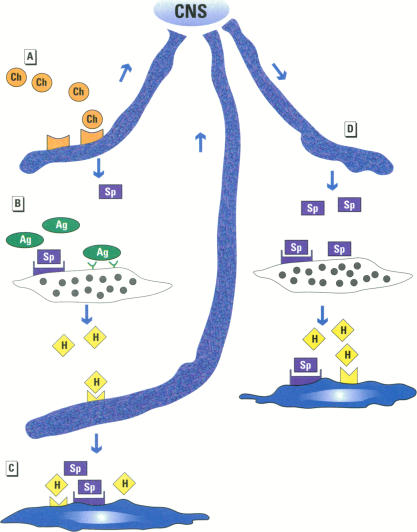
Neurogenic switching is proposed as a hypothesis for a mechanism by which a stimulus at one site can lead to inflammation at a distant site. Neurogenic inflammation occurs when substance P and other neuropeptides released from sensory neurons produce an inflammatory response, whereas immunogenic inflammation results from the binding of antigen to antibody or leukocyte receptors. There is a crossover mechanism between these two forms of inflammation. Neurogenic switching is proposed to result when a sensory impulse from a site of activation is rerouted via the central nervous system to a distant location to produce neurogenic inflammation at the second location. Neurogenic switching is a possible explanation for systemic anaphylaxis, in which inoculation of the skin or gut with antigen produces systemic symptoms involving the respiratory and circulatory systems, and an experimental model of anaphylaxis is consistent with this hypothesis. Food-allergy-iducing asthma, urticaria, arthritis, and fibromyalgia are other possible examples of neurogenic switching. Neurogenic switching provides a mechanism to explain how allergens, infectious agents, irritants, and possibly emotional stress can exacerbate conditions such as migraine, asthma, and arthritis. Because neurogenic inflammation is known to be triggered by chemical exposures, it may play a role in the sick building syndrome and the multiple chemical sensitivity syndrome. Thus neurogenic switching would explain how the respiratory irritants lead to symptoms at other sites in these disorders.
神经源性转换被提出作为一种假说,用以解释一个部位的刺激如何导致远处部位发生炎症。当感觉神经元释放的P物质和其他神经肽产生炎症反应时,就会发生神经源性炎症,而免疫源性炎症则是由抗原与抗体或白细胞受体结合引起的。这两种炎症形式之间存在一种交叉机制。当来自激活部位的感觉冲动通过中枢神经系统重新路由到远处位置,从而在第二个位置产生神经源性炎症时,就会发生神经源性转换。神经源性转换是全身性过敏反应的一种可能解释,在全身性过敏反应中,皮肤或肠道接种抗原会产生涉及呼吸系统和循环系统的全身症状,过敏反应的实验模型与这一假说相符。食物诱发过敏的哮喘、荨麻疹、关节炎和纤维肌痛是神经源性转换的其他可能例子。神经源性转换提供了一种机制,来解释过敏原、传染原、刺激物以及可能的情绪压力如何加重偏头痛、哮喘和关节炎等病症。由于已知神经源性炎症是由化学暴露引发的,它可能在病态建筑综合征和多重化学敏感性综合征中起作用。因此,神经源性转换可以解释在这些疾病中,呼吸道刺激物如何导致其他部位出现症状。