Bolscher J, Veerman E, Van Nieuw Amerongen A, Tulp A, Verwoerd D
Academic Centre for Dentistry Amsterdam, Department of Oral Biochemistry, The Netherlands.
Biochem J. 1995 Aug 1;309 ( Pt 3)(Pt 3):801-6. doi: 10.1042/bj3090801.
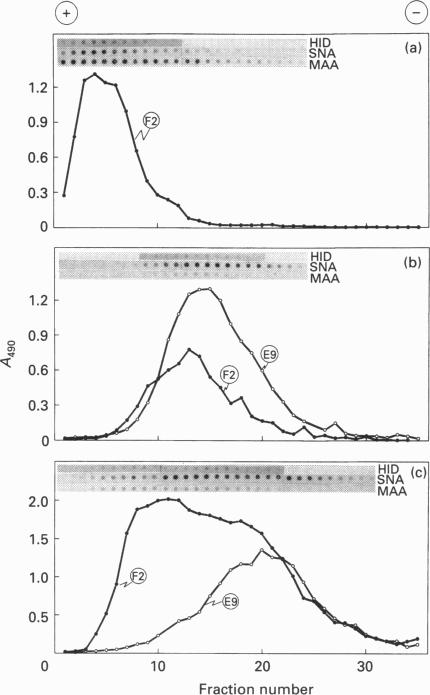
High-M(r) mucins [mucin glycoprotein 1 (MG1)] isolated from human saliva from the individual salivary glands were chemically characterized. The carbohydrate content of MG1 derived from palatal (PAL), submandibular (SM) and sublingual (SL) saliva was typical of mucins but showed heterogeneity, especially in the amount of sialic acid and sulphated sugar residues. The physicochemical properties of native MG1s make conventional SDS/PAGE and ion-exchange chromatography unsuitable for investigating differences between individual samples. Recently a density-gradient electrophoresis (DGE) device has been developed, primarily for separation based on the charge of entire cells or cell organelles [Tulp, Verwoerd and Pieters (1993) Electrophoresis 14, 1295-1301]. We have used this apparatus to study the high-M(r) salivary mucins. Using DGE, the MG1s of individual glands were seen to have clearly distinct electrophoretic mobilities, as monitored by ELISA using MG1-specific monoclonal antibodies. Even within a particular MG1 preparation, subpopulations could be distinguished. DGE analysis of a chemically and enzymically modified MG1 series, followed by ELISA and dot-blot detection using specific monoclonal antibodies, lectins and high-iron diamine staining, suggests that the high electrophoretic mobility of PAL-MG1 is mainly the result of a high sulphate content, whereas the SL subpopulations differ mainly in binding type and amount of sialic acid. SM-MG1 most resembles the low-mobility subpopulation of SL-MG1, except that it has a lower sulphate content. In conclusion, DGE appears to be a powerful method for analysis of native mucin; it has been used to demonstrate that MG1s from the various salivary glands are biochemically much more diverse than was previously assumed.
对从个体唾液腺采集的人唾液中分离出的高分子量(M(r))黏蛋白[黏蛋白糖蛋白1(MG1)]进行了化学表征。源自腭腺(PAL)、下颌下腺(SM)和舌下腺(SL)唾液的MG1的碳水化合物含量具有黏蛋白的典型特征,但存在异质性,尤其是唾液酸和硫酸化糖残基的含量。天然MG1的物理化学性质使得传统的SDS/聚丙烯酰胺凝胶电泳(PAGE)和离子交换色谱法不适用于研究个体样本之间的差异。最近开发了一种密度梯度电泳(DGE)装置,主要用于基于整个细胞或细胞器的电荷进行分离[Tulp、Verwoerd和Pieters(1993年)《电泳》14,1295 - 1301]。我们已使用该仪器研究高分子量唾液黏蛋白。使用DGE时,通过使用MG1特异性单克隆抗体的酶联免疫吸附测定(ELISA)监测发现,各个腺体的MG1具有明显不同的电泳迁移率。即使在特定的MG1制剂中,也可以区分亚群。对化学和酶修饰的MG1系列进行DGE分析,随后使用特异性单克隆抗体、凝集素和高铁二胺染色进行ELISA和斑点印迹检测,结果表明PAL - MG1的高电泳迁移率主要是高硫酸盐含量的结果,而SL亚群主要在唾液酸的结合类型和含量上有所不同。SM - MG1最类似于SL - MG1的低迁移率亚群,只是其硫酸盐含量较低。总之,DGE似乎是分析天然黏蛋白的一种强大方法;它已被用于证明来自各种唾液腺的MG1在生化方面比以前认为的更加多样化。