Mise K, Allison R F, Janda M, Ahlquist P
Institute for Molecular Virology, University of Wisconsin-Madison 53706.
J Virol. 1993 May;67(5):2815-23. doi: 10.1128/JVI.67.5.2815-2823.1993.
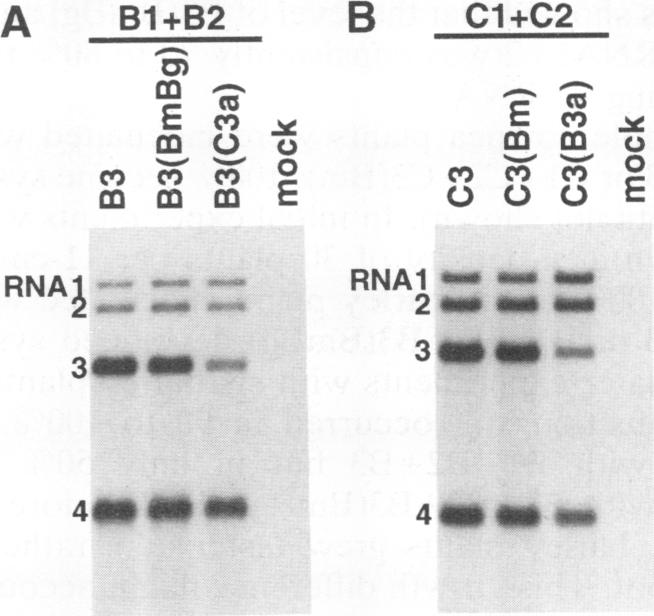
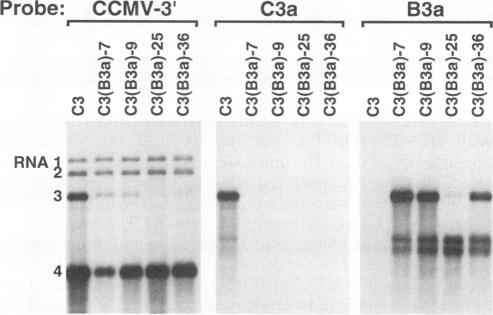
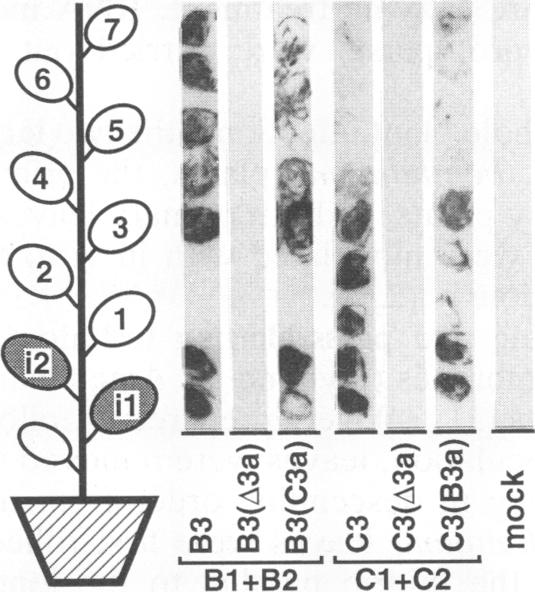
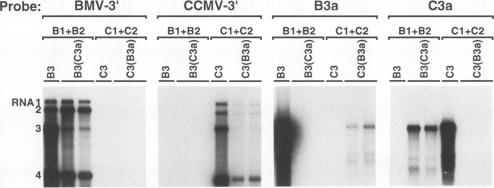
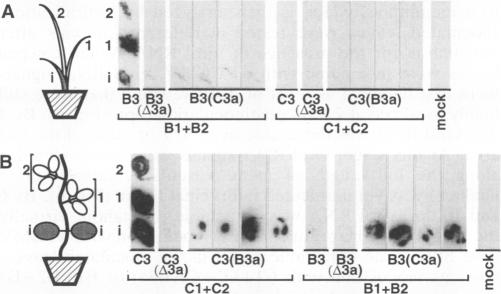
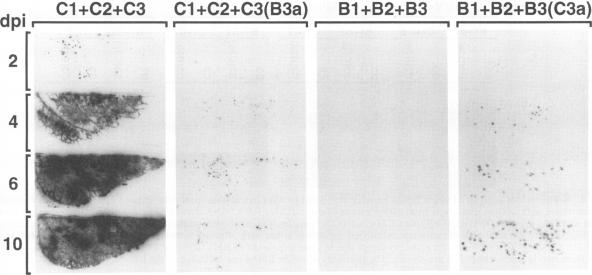
Monocot-adapted brome mosaic virus (BMV) and dicot-adapted cowpea chlorotic mottle virus (CCMV) are closely related bromoviruses with tripartite RNA genomes. Although RNAs 1 and 2 together are sufficient for RNA replication in protoplasts, systemic infection also requires RNA3, which encodes the coat protein and the nonstructural 3a movement protein. We have previously shown with bromoviral reassortants that host specificity determinants in both viruses are encoded by RNA3 as well as by RNA1 and/or RNA2. Here, to test their possible role in host specificity, the 3a movement protein genes were precisely exchanged between BMV and CCMV. The hybrid viruses, but not 3a deletion mutants, systemically infected Nicotiana benthamiana, a permissive host for both parental viruses. The hybrids thus retain basic competence for replication, packaging, cell-to-cell spread, and long-distance (vascular) spread. However, the hybrids failed to systemically infect either barley or cowpea, selective hosts for parental viruses. Thus, the 3a gene and/or its encoded 3a protein contributes to host specificity of both monocot- and dicot-adapted bromoviruses. Tests of inoculated cowpea leaves showed that the spread of the CCMV hybrid containing the BMV 3a gene was blocked at a very early stage of infection. Moreover, the BMV hybrid containing the CCMV 3a gene appeared to spread farther than wt BMV in inoculated cowpea leaves. Several pseudorevertants directing systemic infection in cowpea leaves were obtained from plants inoculated with the CCMV(BMV 3a) hybrid, suggesting that the number of mutations required to adapt the hybrid to dicots is small.
适应单子叶植物的雀麦花叶病毒(BMV)和适应双子叶植物的豇豆褪绿斑驳病毒(CCMV)是密切相关的雀麦病毒,具有三分体RNA基因组。尽管RNA1和RNA2共同足以在原生质体中进行RNA复制,但系统感染还需要RNA3,它编码外壳蛋白和非结构3a运动蛋白。我们之前用雀麦病毒重配体表明,两种病毒中的宿主特异性决定因素由RNA3以及RNA1和/或RNA2编码。在此,为了测试它们在宿主特异性中的可能作用,在BMV和CCMV之间精确交换了3a运动蛋白基因。杂种病毒,而非3a缺失突变体,系统感染了本氏烟草,这是两种亲本病毒的允许宿主。因此,杂种保留了复制、包装、细胞间传播和长距离(维管束)传播的基本能力。然而,杂种未能系统感染大麦或豇豆,它们分别是亲本病毒的选择性宿主。因此,3a基因和/或其编码的3a蛋白有助于适应单子叶和双子叶植物的雀麦病毒的宿主特异性。对接种的豇豆叶片的测试表明,含有BMV 3a基因的CCMV杂种的传播在感染的非常早期阶段就被阻断。此外,含有CCMV 3a基因的BMV杂种在接种的豇豆叶片中似乎比野生型BMV传播得更远。从接种CCMV(BMV 3a)杂种的植物中获得了几个在豇豆叶片中指导系统感染的假回复体,这表明使杂种适应双子叶植物所需的突变数量很少。