Donnelly J J, Ulmer J B, Hawe L A, Friedman A, Shi X P, Leander K R, Shiver J W, Oliff A I, Martinez D, Montgomery D
Department of Cancer Research, Merck Research Laboratories, West Point, PA 19486.
Proc Natl Acad Sci U S A. 1993 Apr 15;90(8):3530-4. doi: 10.1073/pnas.90.8.3530.
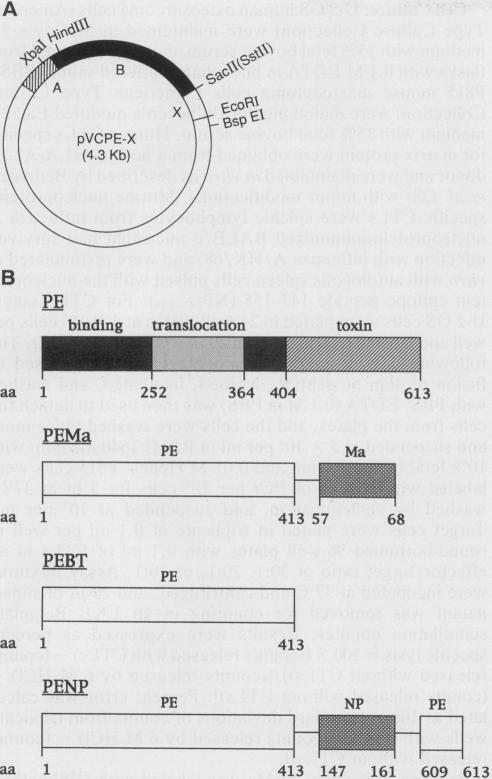
Cytotoxic T lymphocytes (CTLs) expressing the CD8 surface marker recognize peptides in association with major histocompatibility complex (MHC) class I molecules. Although most peptides expressed on MHC class I molecules are derived from self- or virally encoded proteins, delivery of exogenous proteins to the cytosol can result in their being processed for presentation to CTLs on MHC class I molecules. We describe two fusion proteins (PEMa and PENP), consisting of the binding and translocating domains of Pseudomonas exotoxin A (PE), fused to peptide epitopes from influenza A matrix protein and nucleoprotein, respectively. These fusion proteins were internalized and processed by MHC class I-positive target cells, resulting in sensitization of target cells for lysis by peptide-specific CTLs. A point mutation known to interfere with intoxication by wild-type PE also reduced the ability of PEMa to sensitize target cells. Fusion of peptide or polypeptide epitopes with PE provides a potential means of eliciting CTLs without the use of self-replicating agents, as well as a useful probe for studying MHC class I-restricted antigen processing.
表达CD8表面标志物的细胞毒性T淋巴细胞(CTL)识别与主要组织相容性复合体(MHC)I类分子相关的肽段。虽然MHC I类分子上表达的大多数肽段来源于自身或病毒编码的蛋白质,但将外源蛋白质递送至胞质溶胶可导致其被加工处理,以便在MHC I类分子上呈递给CTL。我们描述了两种融合蛋白(PEMa和PENP),它们分别由绿脓杆菌外毒素A(PE)的结合和转运结构域与甲型流感病毒基质蛋白和核蛋白的肽表位融合而成。这些融合蛋白被MHC I类阳性靶细胞内化并加工处理,导致靶细胞对肽特异性CTL的裂解敏感。已知一种干扰野生型PE中毒的点突变也降低了PEMa使靶细胞敏感的能力。肽或多肽表位与PE的融合提供了一种无需使用自我复制剂即可引发CTL的潜在方法,也是研究MHC I类限制抗原加工的有用探针。