Warshawsky I, Bu G, Mast A, Saffitz J E, Broze G J, Schwartz A L
Edward Mallinckrodt Department of Pediatrics, Jewish Hospital, St. Louis, Missouri 63110, USA.
J Clin Invest. 1995 Apr;95(4):1773-81. doi: 10.1172/JCI117855.
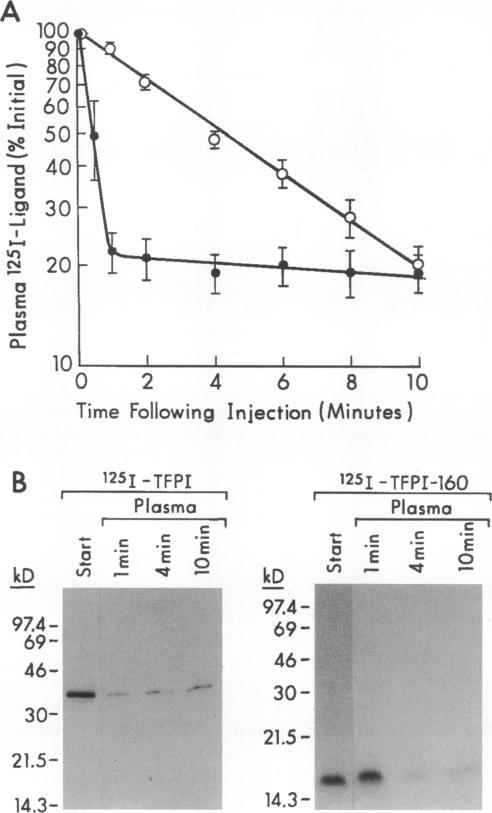
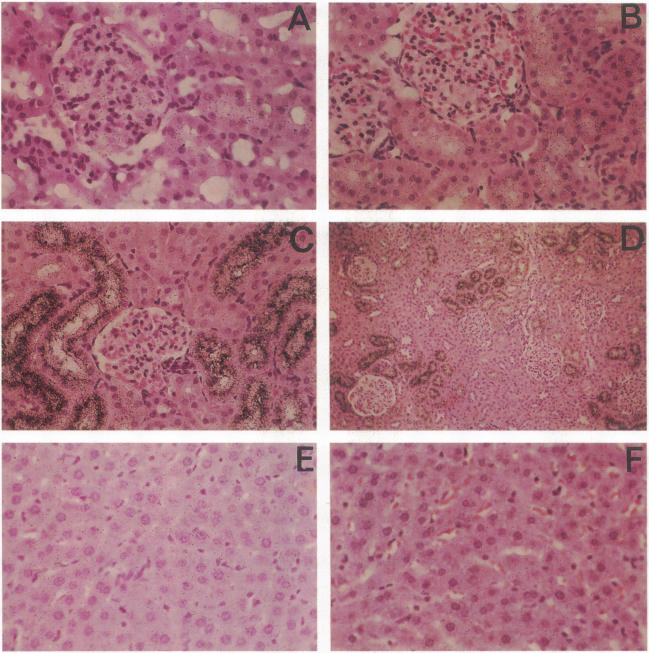
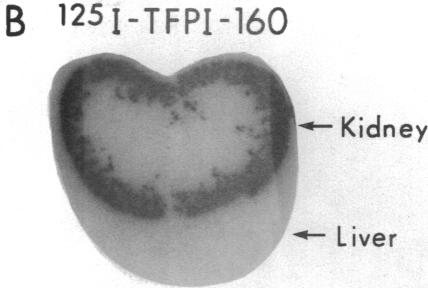
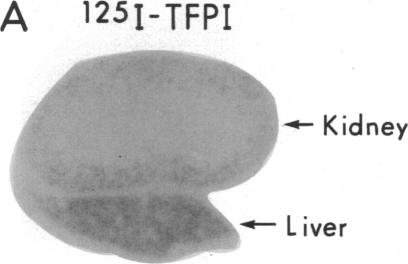
Tissue factor pathway inhibitor (TFPI) is a plasma Kunitz-type serine protease inhibitor that directly inhibits coagulation Factor Xa and also inhibits tissue factor-initiated coagulation. Normal human plasma TFPI exists both as the full-length molecule and as variably carboxy-terminal truncated forms. We reported recently that the low density lipoprotein receptor-related protein mediates the cellular degradation of TFPI after TFPI binding to the hepatoma cell surface. To examine whether the carboxy terminus of TFPI was required for interacting with hepatoma cells, a mutant of TFPI lacking the third Kunitz-type domain and basic carboxy terminus was generated. We found that this mutant, TFPI-160, did not compete with full-length 125I-TFPI-160 for binding to hepatoma cells. We were also unable to demonstrate specific binding of 125I-TFPI-160 to hepatoma cells at 4 degrees C. At 37 degrees C, significantly less 125I-TFPI-160 was internalized and degraded via low density lipoprotein receptor-related protein than full-length 125I-TFPI. Full-length 125I-TFPI binding to hepatoma cells could be inhibited > 90% by heparin and other highly charged molecules. Since TFPI, but not TFPI-160, was capable of effectively binding to cultured hepatoma cells, the fates of TFPI and TFPI-160 in vivo were examined. Both 125I-TFPI and 125I-TFPI-160 disappeared rapidly from the circulation after their intravenous administration into rats. The initial plasma half-life of 125I-TFPI was approximately 30 s whereas the half-life of 125I-TFPI-160 was approximately 4 min. 125I-TFPI was cleared predominantly by the liver. In contrast, 125I-TFPI-160 accumulated in the outer cortex of the kidney. Using microscopic autoradiography, we demonstrate that 125I-TFPI clearance is largely hepatocellular, whereas 125I-TFPI-160 accumulates mainly in the cells of the kidney proximal tubules. Together our findings demonstrate that the carboxy-terminal region(s) distal to amino acid 160 of TFPI mediates TFPI binding to hepatoma cells both in vitro and in vivo.
组织因子途径抑制剂(TFPI)是一种血浆库尼茨型丝氨酸蛋白酶抑制剂,它可直接抑制凝血因子Xa,还能抑制组织因子启动的凝血过程。正常人血浆中的TFPI既以全长分子形式存在,也以羧基末端可变截短形式存在。我们最近报道,低密度脂蛋白受体相关蛋白在TFPI与肝癌细胞表面结合后介导TFPI的细胞内降解。为了研究TFPI的羧基末端是否是与肝癌细胞相互作用所必需的,我们构建了一个缺失第三个库尼茨型结构域和碱性羧基末端的TFPI突变体。我们发现,这个突变体TFPI - 160不能与全长的125I - TFPI - 160竞争结合肝癌细胞。在4℃时,我们也无法证明125I - TFPI - 160与肝癌细胞有特异性结合。在37℃时,与全长的125I - TFPI相比,通过低密度脂蛋白受体相关蛋白内化和降解的125I - TFPI - 160明显更少。肝素和其他高电荷分子可使全长的125I - TFPI与肝癌细胞的结合被抑制>90%。由于TFPI能够有效结合培养的肝癌细胞,而TFPI - 160不能,因此我们研究了TFPI和TFPI - 160在体内的命运。将125I - TFPI和125I - TFPI - 160静脉注射到大鼠体内后,它们都迅速从循环中消失。125I - TFPI的初始血浆半衰期约为30秒,而125I - TFPI - 160的半衰期约为4分钟。125I - TFPI主要通过肝脏清除。相反,125I - TFPI - 160在肾外皮质中蓄积。通过显微放射自显影,我们证明125I - TFPI的清除主要是肝细胞性的,而125I - TFPI - 160主要蓄积在近端肾小管细胞中。我们的研究结果共同表明,TFPI第160位氨基酸远端的羧基末端区域在体外和体内均介导TFPI与肝癌细胞的结合。