Beauchamp G K, Katahira K, Yamazaki K, Mennella J A, Bard J, Boyse E A
Monell Chemical Senses Center, Philadelphia, PA 19104, USA.
Proc Natl Acad Sci U S A. 1995 Mar 28;92(7):2617-21. doi: 10.1073/pnas.92.7.2617.
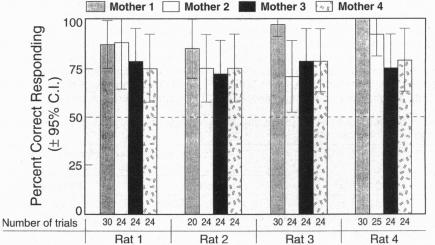
Odortypes--namely, body odors that distinguish one individual from another on the basis of genetic polymorphism at the major histocompatibility complex and other loci--are a fundamental element in the social life and reproductive behavior of the mouse, including familial imprinting, mate choice, and control of early pregnancy. Odortypes are strongly represented in urine. During mouse pregnancy, an outcrossed mother's urine acquires fetal major histocompatibility complex odortypes of paternal origin, an observation that we took as the focus of a search for odortypes in humans, using a fully automated computer-programmed olfactometer in which trained rats are known to distinguish precisely the odortypes of another species. Five women provided urine samples before and after birth, which in each case appropriately trained rats were found to distinguish in the olfactometer. Whether this olfactory distinction of mothers' urine before and after birth reflects in part the odortype and hence genotype of the fetus, and not just the state of pregnancy per se, was tested in a second study in which each mother's postpartum urine was mixed either with urine from her own infant or with urine of a different, same-aged infant. Responses of trained rats were more positive with respect to the former (congruous) mixtures than to the latter (incongruous) mixtures, implying that, as in the mouse, human fetal odortypes of paternal genomic origin are represented in the odortype of the mother, doubtless by circulatory transfer of the pertinent odorants.
气味类型——即基于主要组织相容性复合体及其他位点的基因多态性而使个体相互区分的体味——是小鼠社会生活和生殖行为的基本要素,包括家族印记、配偶选择和早期妊娠控制。气味类型在尿液中表现强烈。在小鼠怀孕期间,杂交母亲的尿液会获得父源的胎儿主要组织相容性复合体气味类型,我们以此为重点,利用一种全自动计算机编程嗅觉计来寻找人类的气味类型,已知经过训练的大鼠能精确区分另一物种的气味类型。五名女性在分娩前后提供了尿液样本,在每种情况下,都发现经过适当训练的大鼠能在嗅觉计中区分这些样本。在第二项研究中,对产后母亲的尿液与自己婴儿的尿液或与另一个同龄婴儿的尿液混合的情况进行了测试,以检验出生前后母亲尿液的这种嗅觉区分是否部分反映了胎儿的气味类型及基因型,而不仅仅是妊娠本身的状态。与后者(不匹配)的混合物相比,训练有素的大鼠对前者(匹配)的混合物反应更积极,这意味着,与小鼠一样,父源基因组的人类胎儿气味类型存在于母亲的气味类型中,无疑是通过相关气味物质的循环转移实现的。