Groot M L, Peterman E J, van Stokkum I H, Dekker J P, van Grondelle R
Department of Physics and Astronomy, Vrije Universiteit, Amsterdam, The Netherlands.
Biophys J. 1995 Jan;68(1):281-90. doi: 10.1016/S0006-3495(95)80186-4.
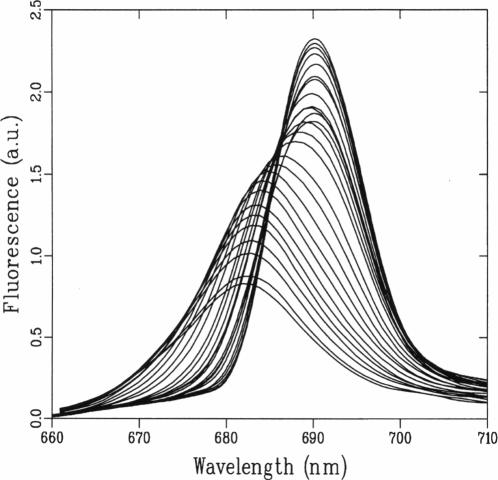
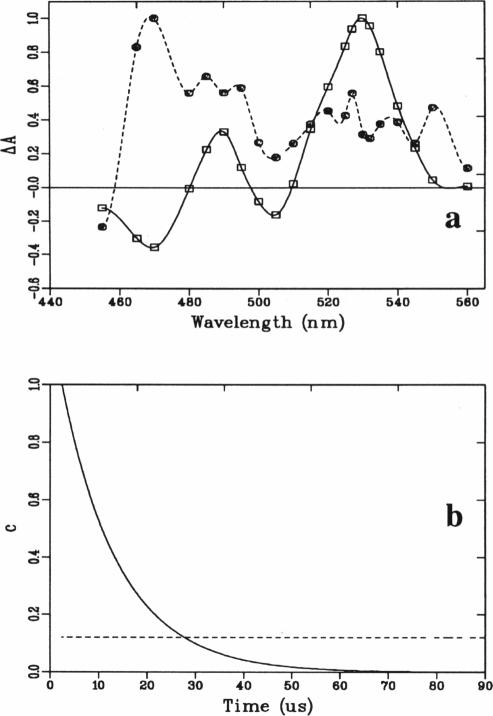
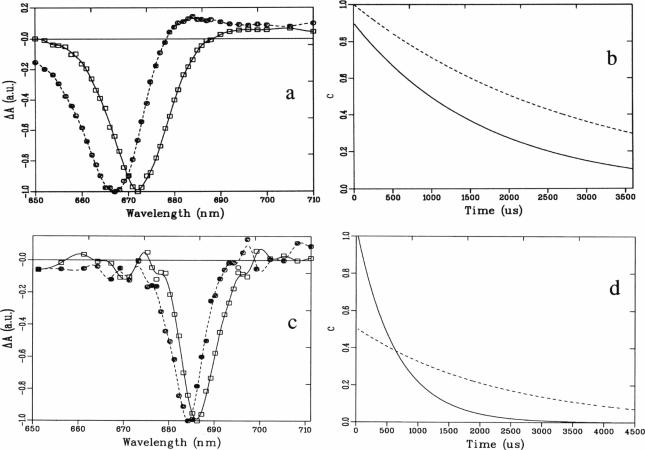
Fluorescence emission and triplet-minus-singlet (T-S) absorption difference spectra of the CP47 core antenna complex of photosystem II were measured as a function of temperature and compared to those of chlorophyll a in Triton X-100. Two spectral species were found in the chlorophyll T-S spectra of CP47, which may arise from a difference in ligation of the pigments or from an additional hydrogen bond, similar to what has been found for Chl molecules in a variety of solvents. The T-S spectra show that the lowest lying state in CP47 is at approximately 685 nm and gives rise to fluorescence at 690 nm at 4 K. The fluorescence quantum yield is 0.11 +/- 0.03 at 4 K, the chlorophyll triplet yield is 0.16 +/- 0.03. Carotenoid triplets are formed efficiently at 4 K through triplet transfer from chlorophyll with a yield of 0.15 +/- 0.02. The major decay channel of the lowest excited state in CP47 is internal conversion, with a quantum yield of about 0.58. Increase of the temperature results in a broadening and blue shift of the spectra due to the equilibration of the excitation over the antenna pigments. Upon increasing the temperature, a decrease of the fluorescence and triplet yields is observed to, at 270 K, a value of about 55% of the low temperature value. This decrease is significantly larger than of chlorophyll a in Triton X-100. Although the coupling to low-frequency phonon or vibration modes of the pigments is probably intermediate in CP47, the temperature dependence of the triplet and fluorescence quantum yield can be modeled using the energy gap law in the strong coupling limit of Englman and Jortner (1970. J. Mol. Phys. 18:145-164) for non-radiative decays. This yields for CP47 an average frequency of the promoting/accepting modes of 350 cm-1 with an activation energy of 650 cm-1 for internal conversion and activationless intersystem crossing to the triplet state through a promoting mode with a frequency of 180 cm-1. For chlorophyll a in Triton X-100 the average frequency of the promoting modes for non-radiative decay is very similar, but the activation energy (300 cm-1) is significantly smaller.
测量了光系统II的CP47核心天线复合物的荧光发射光谱以及三线态减单线态(T-S)吸收差光谱随温度的变化,并与Triton X-100中叶绿素a的相应光谱进行了比较。在CP47的叶绿素T-S光谱中发现了两种光谱类型,这可能源于色素配体的差异或额外的氢键,类似于在多种溶剂中对叶绿素分子的发现。T-S光谱表明,CP47中最低能级的状态位于约685nm处,在4K时会产生690nm的荧光。4K时荧光量子产率为0.11±0.03,叶绿素三线态产率为0.16±'0.03。在4K时,通过叶绿素的三线态转移有效地形成了类胡萝卜素三线态,产率为0.15±0.02。CP47中最低激发态的主要衰变通道是内转换,量子产率约为0.58。温度升高导致光谱展宽和蓝移,这是由于激发在天线色素上达到平衡所致。随着温度升高,观察到荧光和三线态产率降低,在270K时降至约低温值的55%。这种降低明显大于Triton X-10中的叶绿素a。尽管CP47中色素与低频声子或振动模式的耦合可能处于中间状态,但三线态和荧光量子产率的温度依赖性可以使用Englman和Jortner(1970. J. Mol. Phys. 18:145 - 164)在非辐射衰变的强耦合极限下的能隙定律进行建模。对于CP47,促进/接受模式的平均频率为350cm-1,内转换的活化能为650cm-1,通过频率为180cm-1的促进模式无活化能地系间窜越到三线态。对于Triton X-100中的叶绿素a,非辐射衰变促进模式的平均频率非常相似,但活化能(300cm-1)明显较小。