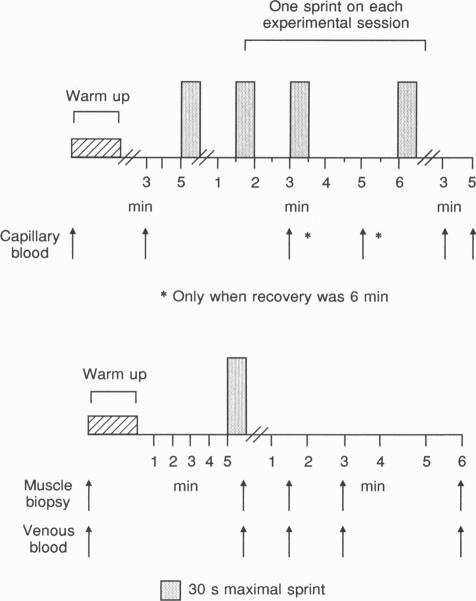
The recovery of power output and muscle metabolites was examined following maximal sprint cycling exercise. Fourteen male subjects performed two 30 s cycle ergometer sprints separated by 1.5, 3 and 6 min of recovery, on three separate occasions. On a fourth occasion eight of the subjects performed only one 30 s sprint and muscle biopsies were obtained during recovery. 2. At the end of the 30 s sprint phosphocreatine (PCr) and ATP contents were 19.7 +/- 1.2 and 70.5 +/- 6.5% of the resting values (rest), respectively, while muscle lactate was 119.0 +/- 4.6 mmol (kg dry wt)-1 and muscle pH was 6.72 +/- 0.06. During recovery, PCr increased rapidly to 65.0 +/- 2.8% of rest after 1.5 min, but reached only 85.5 +/- 3.5% of rest after 6 min of recovery. At the same time ATP and muscle pH remained low (19.5 +/- 0.9 mmol (kg dry wt)-1 and 6.79 +/- 0.02, respectively). Modelling of the individual PCr resynthesis using a power function curve gave an average half-time for PCr resynthesis of 56.6 +/- 7.3 s. 3. Recovery of peak power output (PPO), peak pedal speed (maxSp) and mean power during the initial 6 s (MPO6) of sprint 2 did not reach the control values after 6 min of rest, and occurred in parallel with the resynthesis of PCr, despite the low muscle pH. High correlations (r = 0.71-0.86; P < 0.05) were found between the percentage resynthesis of PCr and the percentage restoration of PPO, maxSp and MPO6 after 1.5 and 3 min of recovery. No relationship was observed between muscle pH recovery and power output restoration during sprint 2 (P > 0.05). 4. These data suggest that PCr resynthesis after 30 s of maximal sprint exercise is slower than previously observed after dynamic exercise of longer duration, and PCr resynthesis is important for the recovery of power during repeated bouts of sprint exercise.