Buée-Scherrer V, Buée L, Hof P R, Leveugle B, Gilles C, Loerzel A J, Perl D P, Delacourte A
INSERM U422, Lille, France.
Am J Pathol. 1995 Apr;146(4):924-32.
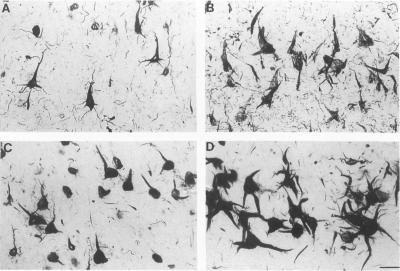
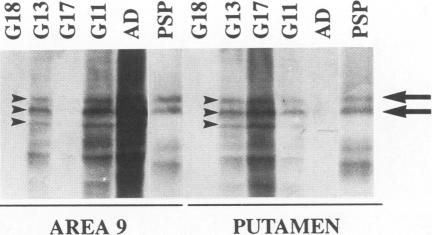
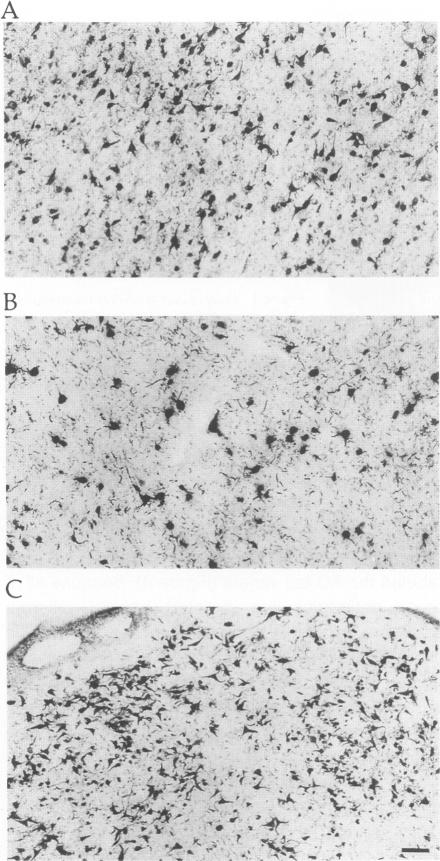
Neurofibrillary tangles are observed in several neurodegenerative disorders including Alzheimer's disease, progressive supranuclear palsy, and amyotrophic lateral sclerosis/parkinsonism-dementia complex of Guam. The major components of neurofibrillary tangles are hyperphosphorylated tau proteins that can be directly detected in brain homogenates, using immunoblotting with specific immunological probes. To investigate whether tau proteins differ biochemically among various neurodegenerative disorders, we analyzed a series of brain samples from Guamanian patients in comparison with Alzheimer's disease, progressive supranuclear palsy, and normal aging. In Alzheimer's disease, these hyperphosphorylated tau proteins are composed of a triplet referred to as tau 55, 64, and 69, whereas in progressive supranuclear palsy, neurofibrillary degeneration is characterized by a tau doublet (tau 64 and 69). In the present study, characterization of tau proteins was performed by immunoblotting, on different cortical and subcortical regions of postmortem brain specimens from Guamanian natives. In all of the cases, biochemical data were always consistent with neuropathological findings. In contrast to Alzheimer's disease patients where the tau triplet is found mostly in cortical regions, a similar triplet was strongly detected in both cortical and subcortical areas in Guamanian patients. The tau profile differed quantitatively from case to case demonstrating that the Alzheimer's disease-related tau triplet had a heterogeneous regional distribution. These data suggest that the tau triplet found in amyotrophic lateral sclerosis/parkinsonism-dementia complex of Guam is similar to that observed in Alzheimer's disease, and the regional distribution of tau proteins differs in these disorders.
在包括阿尔茨海默病、进行性核上性麻痹以及关岛肌萎缩侧索硬化症/帕金森痴呆综合征在内的多种神经退行性疾病中均观察到神经原纤维缠结。神经原纤维缠结的主要成分是过度磷酸化的tau蛋白,可使用特异性免疫探针通过免疫印迹法在脑匀浆中直接检测到。为了研究tau蛋白在各种神经退行性疾病之间是否存在生化差异,我们分析了一系列来自关岛患者的脑样本,并与阿尔茨海默病、进行性核上性麻痹以及正常衰老的样本进行比较。在阿尔茨海默病中,这些过度磷酸化的tau蛋白由被称为tau 55、64和69的三联体组成,而在进行性核上性麻痹中,神经原纤维变性的特征是tau双峰(tau 64和69)。在本研究中,通过免疫印迹法对来自关岛本地人的死后脑标本的不同皮质和皮质下区域进行了tau蛋白的表征分析。在所有病例中,生化数据始终与神经病理学发现一致。与阿尔茨海默病患者不同,阿尔茨海默病患者的tau三联体主要存在于皮质区域,而在关岛患者的皮质和皮质下区域均强烈检测到类似的三联体。tau蛋白谱在不同病例之间存在定量差异,表明与阿尔茨海默病相关的tau三联体具有异质性区域分布。这些数据表明,在关岛肌萎缩侧索硬化症/帕金森痴呆综合征中发现的tau三联体与在阿尔茨海默病中观察到的相似,并且tau蛋白在这些疾病中的区域分布有所不同。