McLaughlin M E, Ehrhart T L, Berson E L, Dryja T P
Howe Laboratory of Ophthalmology, Harvard Medical School, Massachusetts Eye and Ear Infirmary, Boston 02114, USA.
Proc Natl Acad Sci U S A. 1995 Apr 11;92(8):3249-53. doi: 10.1073/pnas.92.8.3249.
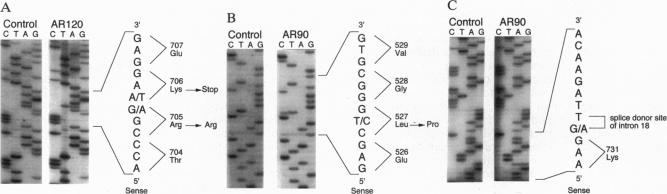
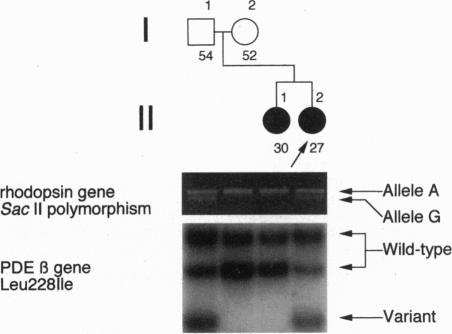
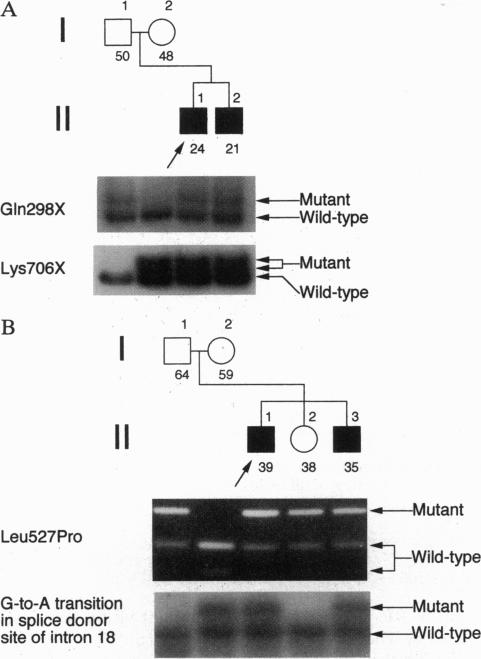
Mutations in the gene encoding the beta subunit of rod cGMP phosphodiesterase are known causes of photoreceptor degeneration in two animal models of retinitis pigmentosa, the rd (retinal degeneration) mouse and the Irish setter dog with rod/cone dysplasia. Here we report a screen of 92 unrelated patients with autosomal recessive retinitis pigmentosa for defects in the human homologue of this gene. We identified seven different mutations that cosegregate with the disease. They were found among four patients with each patient heterozygously carrying two mutations. All of these mutations are predicted to affect the putative catalytic domain, probably leading to a decrease in phosphodiesterase activity and an increase in cGMP levels within rod photoreceptors. Mutations in the gene encoding the beta subunit of rod phosphodiesterase are the most common identified cause of autosomal recessive retinitis pigmentosa, accounting for approximately 4% of cases in North America.
视杆细胞环鸟苷酸磷酸二酯酶β亚基编码基因的突变是视网膜色素变性两种动物模型(rd(视网膜变性)小鼠和患有视杆/视锥发育异常的爱尔兰赛特犬)中光感受器退化的已知病因。在此,我们报告了对92名常染色体隐性视网膜色素变性无关患者进行该基因人类同源物缺陷筛查的情况。我们鉴定出了7种与该疾病共分离的不同突变。这些突变存在于4名患者中,每名患者均杂合携带两种突变。所有这些突变预计会影响假定的催化结构域,可能导致磷酸二酯酶活性降低以及视杆光感受器内的环鸟苷酸水平升高。视杆磷酸二酯酶β亚基编码基因的突变是常染色体隐性视网膜色素变性最常见的已知病因,在北美约占病例的4%。