Suber M L, Pittler S J, Qin N, Wright G C, Holcombe V, Lee R H, Craft C M, Lolley R N, Baehr W, Hurwitz R L
College of Optometry, University of Houston, TX 77204.
Proc Natl Acad Sci U S A. 1993 May 1;90(9):3968-72. doi: 10.1073/pnas.90.9.3968.
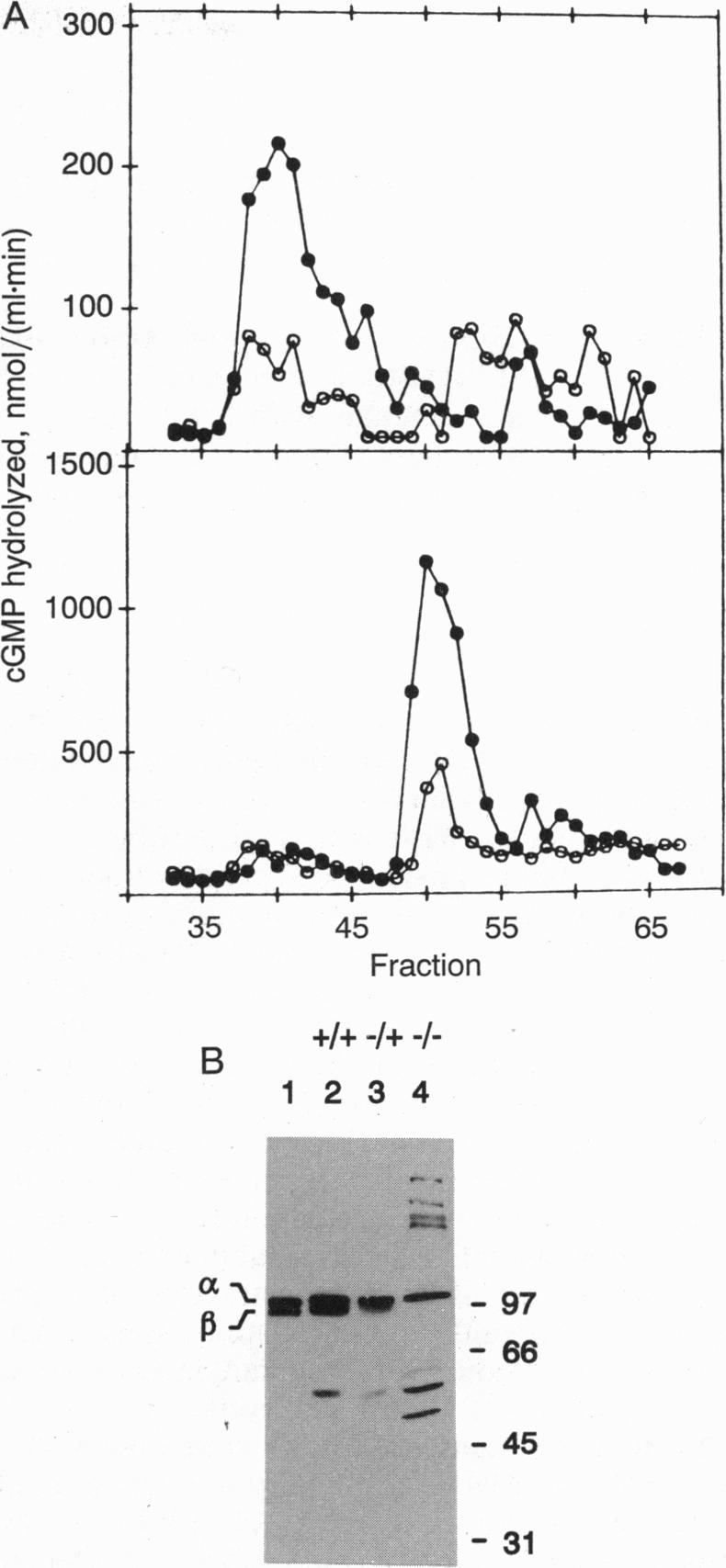
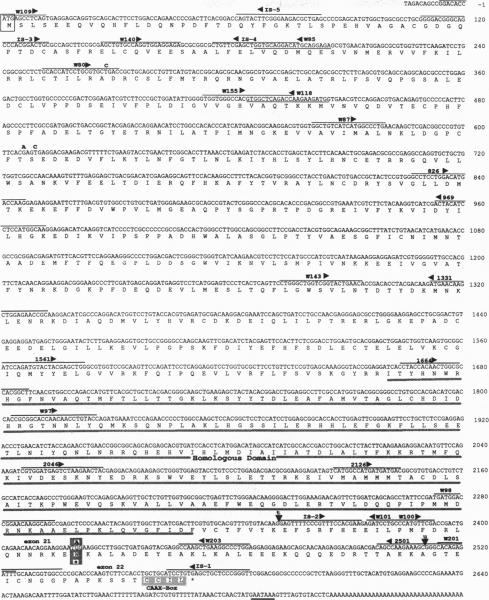
Irish setter dogs affected with a rod/cone dysplasia (locus designation, rcd1) display markedly elevated levels of retinal cGMP during postnatal development. The photoreceptor degeneration commences approximately 25 days after birth and culminates at about 1 year when the population of rods and cones is depleted. A histone-sensitive retinal cGMP phosphodiesterase (PDE; EC 3.1.4.35) activity, a marker for photoreceptor PDEs, was shown previously to be present in retinal homogenates of immature, affected Irish setters. Here we report that, as judged by HPLC separation, this activity originates exclusively from cone photoreceptors, whereas rod PDE activity is absent. An immunoreactive product the size of the PDE alpha subunit, but none the size of the beta subunit, can be detected on immunoblots of retinal extracts of affected dogs, suggesting a null mutation in the PDE beta-subunit gene. Using PCR amplification of Irish setter retinal cDNA, we determined the complete coding sequence of the PDE beta subunit in heterozygous and affected animals. The affected PDE beta-subunit mRNA contained a nonsense amber mutation at codon 807 (a G-->A transition converting TGG to TAG), which was confirmed to be present in putative exon 21 of the affected beta-subunit gene. The premature stop codon truncates the beta subunit by 49 residues, thus removing the C-terminal domain that is required for posttranslational processing and membrane association. These results suggest that the rcd1 gene encodes the rod photoreceptor PDE beta subunit and that a nonsense mutation in this gene is responsible for the production of a nonfunctional rod PDE and the photoreceptor degeneration in the rcd1/rcd1 Irish setter dogs.
患有视杆/视锥发育异常(基因座命名为rcd1)的爱尔兰雪达犬在出生后发育过程中视网膜cGMP水平显著升高。光感受器退化在出生后约25天开始,在约1岁时达到顶峰,此时视杆和视锥细胞数量减少。一种对组蛋白敏感的视网膜cGMP磷酸二酯酶(PDE;EC 3.1.4.35)活性,作为光感受器PDE的标志物,先前已证实在未成熟的患病爱尔兰雪达犬的视网膜匀浆中存在。在此我们报告,通过高效液相色谱分离判断,这种活性仅来源于视锥光感受器,而视杆PDE活性不存在。在患病犬的视网膜提取物免疫印迹上可检测到PDEα亚基大小的免疫反应产物,但未检测到β亚基大小的产物,提示PDEβ亚基基因存在无效突变。利用爱尔兰雪达犬视网膜cDNA的PCR扩增,我们确定了杂合子和患病动物中PDEβ亚基的完整编码序列。患病的PDEβ亚基mRNA在密码子807处含有一个无义琥珀突变(G→A转换,将TGG变为TAG),证实存在于患病β亚基基因的推定外显子21中。过早的终止密码子使β亚基截短49个残基,从而去除了翻译后加工和膜结合所需的C末端结构域。这些结果表明,rcd1基因编码视杆光感受器PDEβ亚基,该基因中的无义突变导致了无功能视杆PDE的产生以及rcd1/rcd1爱尔兰雪达犬的光感受器退化。