Liu Y, Leibowitz M J
Department of Molecular Genetics and Microbiology, UMDNJ-Robert Wood Johnson Medical School, Piscataway 08854-5635, USA.
Nucleic Acids Res. 1995 Apr 25;23(8):1284-91. doi: 10.1093/nar/23.8.1284.
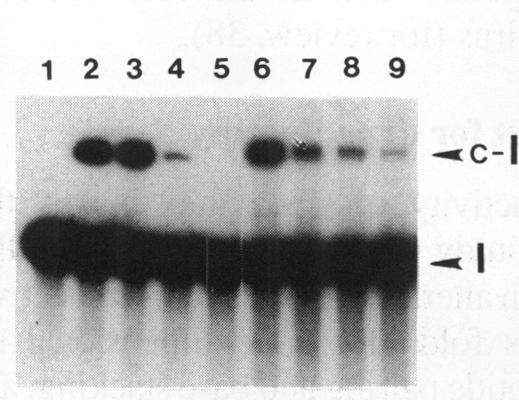
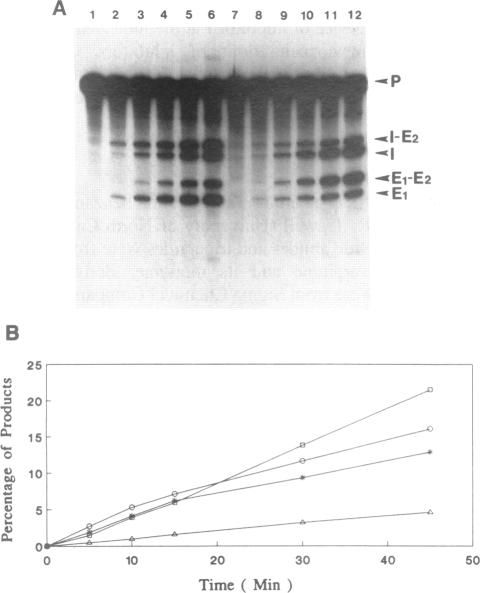
The group I self-splicing introns found in many organisms are competitively inhibited by L-arginine. We have found that L-arginine acts stereoselectively on the Pc1. LSU nuclear group I intron of Pneumocystis carinii, competitively inhibiting the first (cleavage) step of the splicing reaction and stimulating the second (ligation) step. Stimulation of the second step is most clearly demonstrated in reactions whose first step is blocked after 15 min by addition of pentamidine. The guanidine moiety of arginine is required for both effects. L-Canavanine is a more potent inhibitor than L-arginine yet it fails to stimulate. L-Arginine derivatized on its carboxyl group as an amide, ester or peptide is more potent than L-arginine as a stimulator and inhibitor, with di-arginine amide and tri-arginine being the most potent effectors tested. The most potent peptides tested are 10,000 times as effective as L-arginine in inhibiting ribozyme activity, and nearly 400 times as effective as stimulators. Arginine and some of its derivatives apparently bind to site(s) on the ribozyme to alter its conformation to one more active in the second step of splicing while competing with guanosine substrate in the first step. This phenomenon indicates that ribozymes, like protein enzymes, can be inhibited or stimulated by non-substrate low molecular weight compounds, which suggests that such compounds may be developed as pharmacological agents acting on RNA targets.
在许多生物体中发现的I组自我剪接内含子受到L-精氨酸的竞争性抑制。我们发现L-精氨酸对卡氏肺孢子虫的Pc1. LSU核I组内含子具有立体选择性作用,竞争性抑制剪接反应的第一步(切割)并刺激第二步(连接)。在第一步反应15分钟后通过添加喷他脒阻断的反应中,最清楚地证明了对第二步的刺激作用。精氨酸的胍基对这两种作用都是必需的。L-刀豆氨酸是比L-精氨酸更有效的抑制剂,但它不能起到刺激作用。在羧基上衍生为酰胺、酯或肽的L-精氨酸作为刺激剂和抑制剂比L-精氨酸更有效,其中二精氨酸酰胺和三精氨酸是测试过的最有效的效应物。测试的最有效的肽在抑制核酶活性方面比L-精氨酸有效10000倍,在作为刺激剂方面比L-精氨酸有效近400倍。精氨酸及其一些衍生物显然与核酶上的位点结合,以将其构象改变为在剪接第二步中更具活性的构象,同时在第一步中与鸟苷底物竞争。这种现象表明,核酶与蛋白质酶一样,可以被非底物低分子量化合物抑制或刺激,这表明此类化合物可能被开发为作用于RNA靶点的药物。