Avignon A, Standaert M L, Yamada K, Mischak H, Spencer B, Farese R V
Department of Internal Medicine and Biochemistry, J.A. Haley Veterans' Hospital, University of South Florida College of Medicine, Tampa 33612, USA.
Biochem J. 1995 May 15;308 ( Pt 1)(Pt 1):181-7. doi: 10.1042/bj3080181.
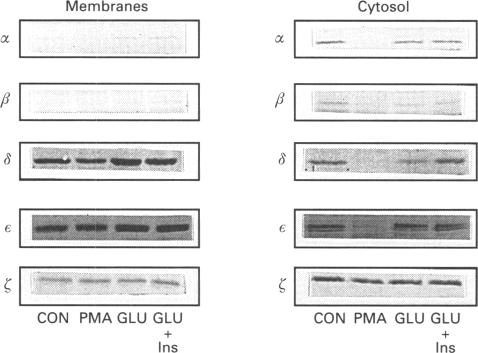
Effects of insulin of levels of mRNA encoding protein kinase C (PKC)-alpha, PKC-beta, PKC-epsilon and PKC-theta were examined by ribonuclease protection assay in primary cultures of rat adipocytes in vitro, and in rat adipose tissue and gastrocnemius muscle in vivo. In all cases, insulin increased the levels of PKC-alpha mRNA and PKC-beta mRNA, and, in muscle, insulin also increased the level of PKC-theta mRNA. PKC-epsilon mRNA levels, on the other hand, were not altered significantly. Insulin also stimulated the apparent translocation of PKC-alpha, -beta, -epsilon and -theta, to the membrane fractions of adipocytes, adipose tissue and gastrocnemius muscles, and, in some instances, total PKC levels were diminished, e.g. PKC-alpha and PKC-beta in cultured adipocytes in vitro and/or whole adipose tissue in vivo, and PKC-alpha and PKC-theta in the gastrocnemius muscle. Thus, insulin-induced increases in PKC mRNA may have been partly compensatory in nature to restore PKC levels following translocation and proteolytic losses. However, much more severe depletion of PKC-alpha and PKC-beta by phorbol ester treatment in cultured rat adipocytes in vitro resulted in, if anything, smaller increases in PKC-alpha mRNA and PKC-beta mRNA, and it therefore appears that insulin effects on PKC mRNA levels were not simply due to decreases in respective PKC levels. In addition, effects of insulin, particularly on PKC-beta mRNA, could not be attributed to increased glucose metabolism, which alone decreased PKC-beta mRNA in cultured adipocytes in vitro. We conclude that insulin-induced translocation and degradation of PKC-alpha, PKC-beta and PKC-theta are attended by selective increases in their mRNAs. This mechanism of increasing mRNA may be important in maintaining PKC levels during the continued action of insulin.
采用核糖核酸酶保护分析法,在体外大鼠脂肪细胞原代培养物以及体内大鼠脂肪组织和腓肠肌中,检测胰岛素对编码蛋白激酶C(PKC)-α、PKC-β、PKC-ε和PKC-θ的mRNA水平的影响。在所有情况下,胰岛素均提高了PKC-α mRNA和PKC-β mRNA的水平,并且在肌肉中,胰岛素还提高了PKC-θ mRNA的水平。另一方面,PKC-ε mRNA水平未发生显著改变。胰岛素还刺激了PKC-α、-β、-ε和-θ向脂肪细胞、脂肪组织和腓肠肌的膜部分明显转位,并且在某些情况下,总PKC水平降低,例如体外培养的脂肪细胞和/或体内整个脂肪组织中的PKC-α和PKC-β,以及腓肠肌中的PKC-α和PKC-θ。因此,胰岛素诱导的PKC mRNA增加在本质上可能部分具有代偿性,以在转位和蛋白水解损失后恢复PKC水平。然而,在体外培养的大鼠脂肪细胞中用佛波酯处理使PKC-α和PKC-β更严重地耗竭,结果是PKC-α mRNA和PKC-β mRNA的增加更小,如果有变化的话,因此看来胰岛素对PKC mRNA水平的影响并非仅仅由于各自PKC水平的降低。此外,胰岛素的作用,特别是对PKC-β mRNA的作用,不能归因于葡萄糖代谢增加,仅葡萄糖代谢增加就会降低体外培养的脂肪细胞中的PKC-β mRNA。我们得出结论,胰岛素诱导的PKC-α、PKC-β和PKC-θ的转位和降解伴随着它们mRNA的选择性增加。这种增加mRNA的机制在胰岛素持续作用期间维持PKC水平可能很重要。