Prowse K R, Greider C W
Cold Spring Harbor Laboratory, NY 11724, USA.
Proc Natl Acad Sci U S A. 1995 May 23;92(11):4818-22. doi: 10.1073/pnas.92.11.4818.
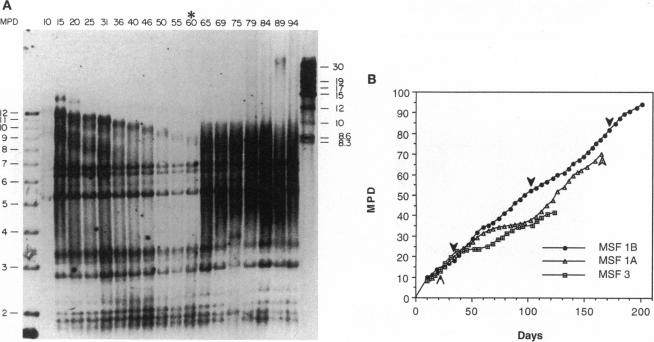
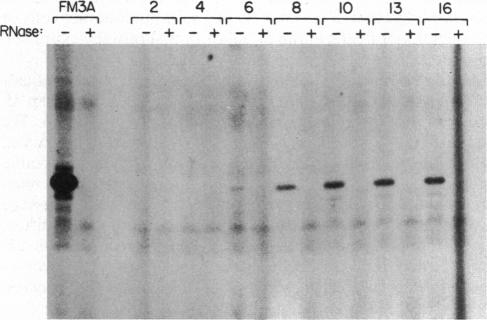
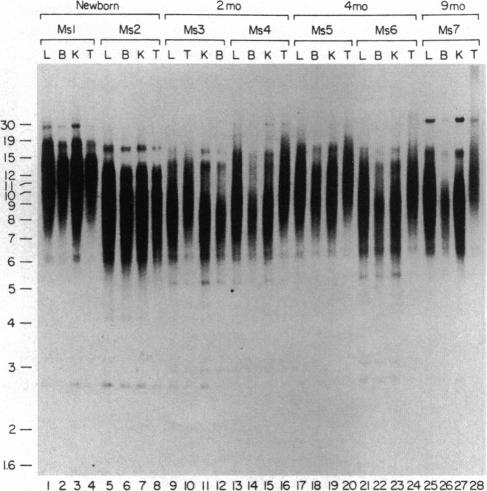
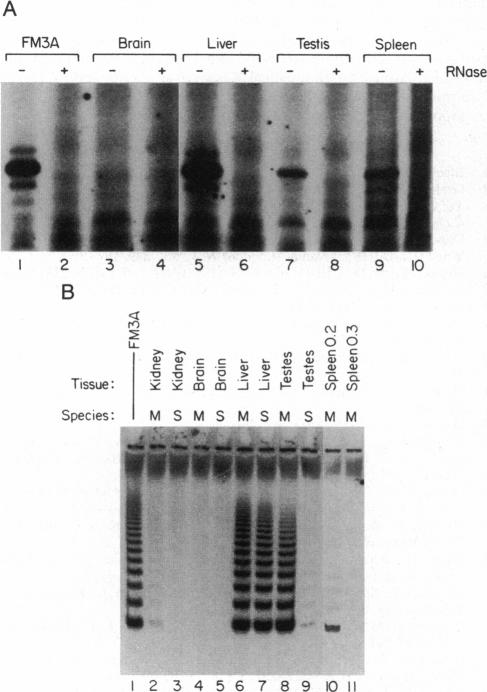
Telomere shortening and telomerase activation in human somatic cells have been implicated in cell immortalization and cellular senescence. To further study the role of telomerase in immortalization, we assayed telomere length and telomerase activity in primary mouse fibroblasts, in spontaneously immortalized cell clones, and in mouse tissues. In the primary cell cultures, telomere length decreased with increased cell doublings and telomerase activity was not detected. In contrast, in spontaneously immortalized clones, telomeres were maintained at a stable length and telomerase activity was present. To determine if telomere shortening occurs in vivo, we assayed for telomerase and telomere length in tissues from mice of different ages. Telomere length was similar among different tissues within a newborn mouse, whereas telomere length differed between tissues in an adult mouse. These findings suggest that there is tissue-specific regulation of mouse telomerase during development and aging in vivo. In contrast to human tissues, most mouse tissues had active telomerase. The presence of telomerase in these tissues may reflect the ease of immortalization of primary mouse cells relative to human cells in culture.
人类体细胞中的端粒缩短和端粒酶激活与细胞永生化和细胞衰老有关。为了进一步研究端粒酶在永生化中的作用,我们检测了原代小鼠成纤维细胞、自发永生化细胞克隆以及小鼠组织中的端粒长度和端粒酶活性。在原代细胞培养物中,端粒长度随着细胞倍增次数的增加而缩短,且未检测到端粒酶活性。相反,在自发永生化克隆中,端粒维持在稳定长度且存在端粒酶活性。为了确定体内是否发生端粒缩短,我们检测了不同年龄小鼠组织中的端粒酶和端粒长度。新生小鼠不同组织间的端粒长度相似,而成年小鼠不同组织间的端粒长度存在差异。这些发现表明,在体内发育和衰老过程中,小鼠端粒酶存在组织特异性调控。与人类组织不同,大多数小鼠组织具有活跃的端粒酶。这些组织中端粒酶的存在可能反映了原代小鼠细胞相对于培养中的人类细胞更容易永生化。