Linstedt A D, Foguet M, Renz M, Seelig H P, Glick B S, Hauri H P
Department of Pharmacology, University of Basel, Switzerland.
Proc Natl Acad Sci U S A. 1995 May 23;92(11):5102-5. doi: 10.1073/pnas.92.11.5102.
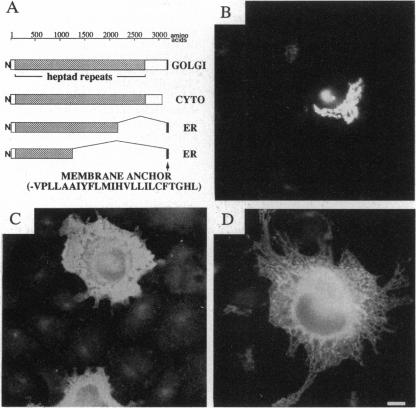
Unlike conventional membrane proteins of the secretory pathway, proteins anchored to the cytoplasmic surface of membranes by hydrophobic sequences near their C termini follow a posttranslational, signal recognition particle-independent insertion pathway. Many such C-terminally-anchored proteins have restricted intracellular locations, but it is not known whether these proteins are targeted directly to the membranes in which they will ultimately reside. Here we have analyzed the intracellular sorting of the Golgi protein giantin, which consists of a rod-shaped 376-kDa cytoplasmic domain followed by a hydrophobic C-terminal anchor sequence. Unexpectedly, we find that giantin behaves like a conventional secretory protein in that it inserts into the endoplasmic reticulum (ER) and then is transported to the Golgi. A deletion mutant lacking a portion of the cytoplasmic domain adjacent to the membrane anchor still inserts into the ER but fails to reach the Golgi, even though this mutant has a stable folded structure. These findings suggest that the localization of a C-terminally-anchored Golgi protein involves at least three steps: insertion into the ER membrane, controlled incorporation into transport vesicles, and retention within the Golgi.
与分泌途径中的传统膜蛋白不同,通过靠近其C末端的疏水序列锚定在膜细胞质表面的蛋白质遵循一种翻译后、不依赖信号识别颗粒的插入途径。许多这样的C末端锚定蛋白在细胞内的定位受限,但尚不清楚这些蛋白是否直接靶向它们最终所在的膜。在这里,我们分析了高尔基体蛋白巨蛋白的细胞内分选,它由一个376 kDa的杆状细胞质结构域和一个疏水的C末端锚定序列组成。出乎意料的是,我们发现巨蛋白的行为类似于传统的分泌蛋白,它插入内质网(ER),然后被运输到高尔基体。一个缺失了与膜锚定相邻的部分细胞质结构域的缺失突变体仍然插入内质网,但未能到达高尔基体,尽管这个突变体具有稳定的折叠结构。这些发现表明,C末端锚定的高尔基体蛋白的定位至少涉及三个步骤:插入内质网膜、受控纳入运输囊泡以及保留在高尔基体中。