Shea T B, Beermann M L
Laboratories for Molecular Neuroscience, Mailman Research Center, McLean Hospital, Belmont, Massachusetts 02178.
Mol Biol Cell. 1994 Aug;5(8):863-75. doi: 10.1091/mbc.5.8.863.
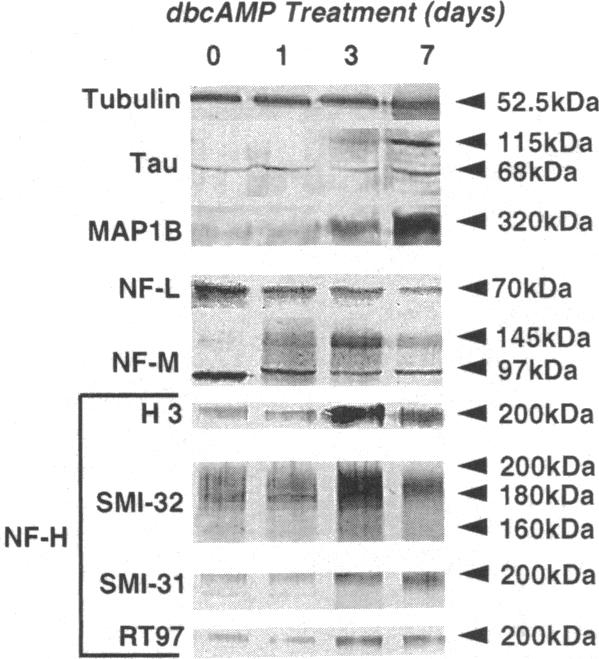
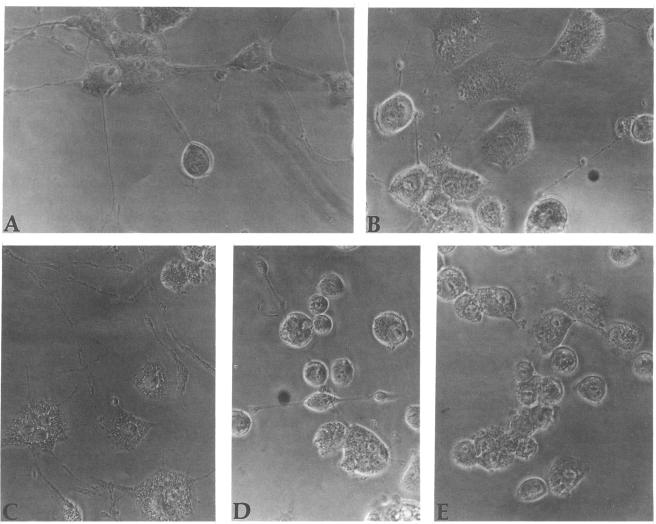
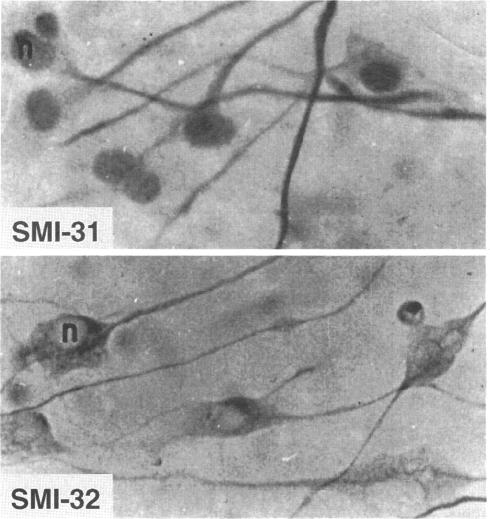
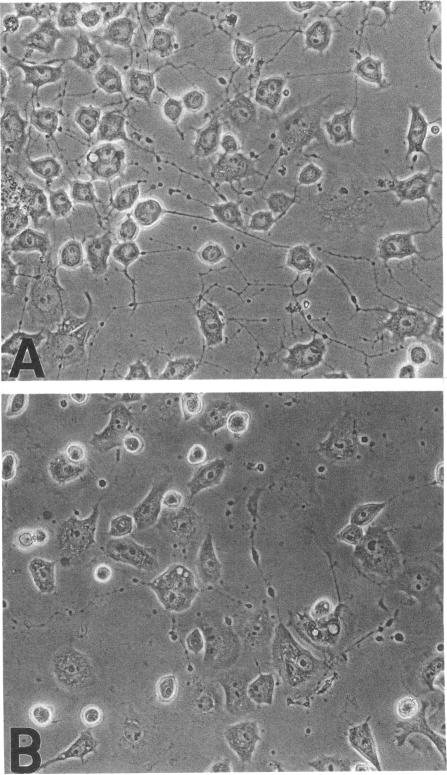
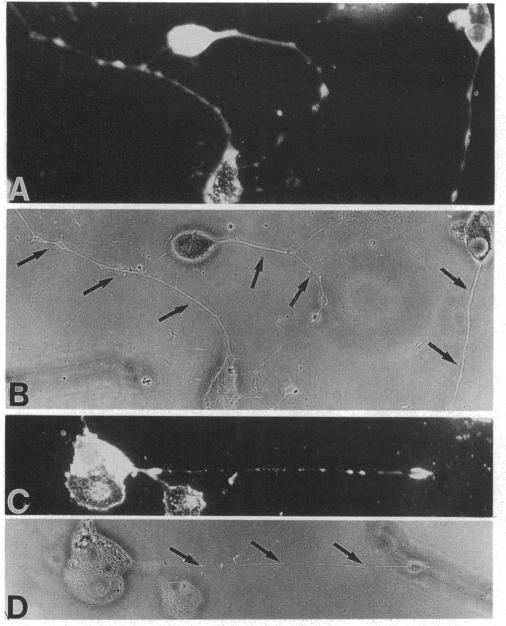
The respective roles of neurofilaments (NFs), microtubules (MTs), and the microtubule-associated proteins (MAPs) MAP 1B and tau on neurite outgrowth and stabilization were probed by the intracellular delivery of specific antisera into transiently permeabilized NB2a/d1 cells during treatment with dbcAMP. Intracellular delivery of antisera specific for the low (NF-L), middle (NF-M), or extensively phosphorylated high (NF-H) molecular weight subunits did not prevent initial neurite elaboration, nor did it induce retraction of existing neurites elaborated by cells that had been previously treated for 1 d with dbcAMP. By contrast, intracellular delivery of antisera directed against tubulin reduced the percentage of cells with neurites at both these time points. Intracellular delivery of anti-NF-L and anti-NF-M antisera did not induce retraction in cells treated with dbcAMP for 3 d. However, intracellular delivery of antisera directed against extensively phosphorylated NF-H, MAP1B, tau, or tubulin induced similar levels of neurite retraction at this time. Intracellular delivery of monoclonal antibodies (RT97 or SMI-31) directed against phosphorylated NF-H induced neurite retraction in cell treated with dbcAMP for 3 d; a monoclonal antibody (SMI-32) directed against nonphosphorylated NF-H did not induce neurite retraction at this time. By contrast, none of the above antisera induced retraction of neurites in cells treated with dbcAMP for 7 d. Neurites develop resistance to retraction by colchicine, first detectable in some neurites after 3 d and in the majority of neurites after 7 d of dbcAMP treatment. We therefore examined whether or not colchicine resistance was compromised by intracellular delivery of the above antisera. Colchicine treatment resulted in rapid neurite retraction after intracellular delivery of antisera directed against extensively phosphorylated NF-H, MAP1B, or tau into cells that had previously been treated with dbcAMP for 7 d. By contrast, colchicine resistance was not compromised by the intracellular delivery of antisera directed against NF-L, NF-M, or tubulin. These findings support previous studies indicating that MT polymerization mediates certain aspects of axonal neurite outgrowth and suggest that NFs do not directly participate in these events. These findings further suggest that NFs function in stabilization of the axonal cytoskeleton, apparently by interactions among NFs and MTs that are mediated by NF-H and MAPs.
在使用二丁酰环磷腺苷(dbcAMP)处理期间,通过将特异性抗血清细胞内递送至瞬时通透的NB2a/d1细胞中,探究了神经丝(NFs)、微管(MTs)以及微管相关蛋白(MAPs)MAP 1B和tau在神经突生长和稳定中的各自作用。针对低分子量(NF-L)、中分子量(NF-M)或高度磷酸化的高分子量(NF-H)亚基的特异性抗血清的细胞内递送,既未阻止初始神经突的形成,也未诱导先前用dbcAMP处理1天的细胞所形成的现有神经突的回缩。相比之下,针对微管蛋白的抗血清的细胞内递送在这两个时间点均降低了有神经突的细胞百分比。抗NF-L和抗NF-M抗血清的细胞内递送并未在经dbcAMP处理3天的细胞中诱导回缩。然而,针对高度磷酸化的NF-H、MAP1B、tau或微管蛋白的抗血清的细胞内递送在此时诱导了相似程度的神经突回缩。针对磷酸化NF-H的单克隆抗体(RT97或SMI-31)的细胞内递送在经dbcAMP处理3天的细胞中诱导了神经突回缩;针对非磷酸化NF-H的单克隆抗体(SMI-32)此时未诱导神经突回缩。相比之下,上述抗血清均未在经dbcAMP处理7天的细胞中诱导神经突回缩。神经突对秋水仙碱诱导的回缩产生抗性,在dbcAMP处理3天后在一些神经突中首次可检测到,在处理7天后在大多数神经突中可检测到。因此,我们研究了上述抗血清的细胞内递送是否会损害秋水仙碱抗性。在用dbcAMP预先处理7天的细胞中,将针对高度磷酸化的NF-H、MAP1B或tau的抗血清细胞内递送后,秋水仙碱处理导致神经突迅速回缩。相比之下,针对NF-L、NF-M或微管蛋白的抗血清的细胞内递送并未损害秋水仙碱抗性。这些发现支持了先前的研究,表明微管聚合介导轴突神经突生长的某些方面,并表明神经丝不直接参与这些事件。这些发现进一步表明,神经丝在轴突细胞骨架的稳定中起作用,显然是通过由NF-H和MAPs介导的神经丝与微管之间的相互作用。