Mardassi H, Wilson L, Mounir S, Dea S
Centre de Recherche en Virologie, Institut Armand-Frappier, Université du Québec, Laval, Canada.
J Clin Microbiol. 1994 Sep;32(9):2197-203. doi: 10.1128/jcm.32.9.2197-2203.1994.
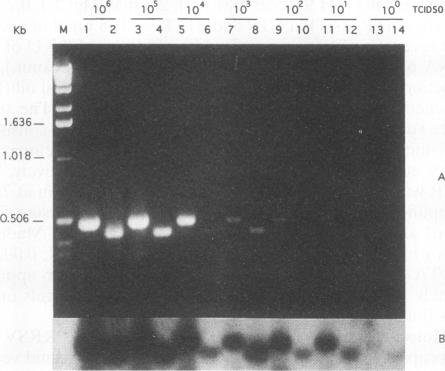
Two sets of oligonucleotide primers (1008PS-1009PR and 1010PLS-1011PLR) were designed according to the sequence of the nucleocapsid protein (N) gene of Quebec reference strain IAF-exp91 of porcine reproductive and respiratory syndrome virus (PRRSV). The primers were used in reverse transcription and PCR (RT-PCR) experiments for detection of viral genomic RNA either from infected porcine alveolar macrophages (PAM) or tissues from experimentally infected specific-pathogen-free pigs. Considering the high degree of variation detected between the nucleotide sequences of the N genes of IAF-exp91 and Lelystad virus (LV) strains of PRRSV, the primers 1008PS-1009PR were referred to as the specific primers, since they were chosen in such a manner that they could amplify only sequences from IAF-exp91 RNA and not from LV. On the other hand, the primer pair 1010PLS-1011PLR was common to both strains of PRRSV. When analyzed by agarose gel electrophoresis, the products of RT-PCR from each set of primers were resolved as single band of the predicted size, the specificity of amplified products being confirmed by Southern blotting with a specific IAF-exp91 N gene probe. No amplification was observed when RNA was extracted from uninfected PAM or from other porcine viruses. As expected, only the common primer pair was able to amplify RNA from the Quebec reference strain and two European strains (LV and Weybridge). The resulting bands displayed differences in electrophoretic mobilities due to the absence of 37 nucleotides in both European strains, thus allowing their differentiation from the IAF-exp91 strain. Most of the tissue culture-adapted Quebec isolates were detected with both primer pairs. The sensitivity of the enzymatic amplification method for detection of PRRSV from lung tissues was a 50% tissue culture infective dose of 5. RT-PCR was found to be more sensitive than indirect immunofluorescence assay for detection of PRRSV in tissues from experimentally infected pigs and as sensitive as virus isolation in PAM, especially when combined with Southern blotting with the digoxigenin-labeled N probe and chemiluminescence detection.
根据猪繁殖与呼吸综合征病毒(PRRSV)魁北克参考毒株IAF-exp91核衣壳蛋白(N)基因的序列设计了两组寡核苷酸引物(1008PS-1009PR和1010PLS-1011PLR)。这些引物用于逆转录和PCR(RT-PCR)实验,以检测来自感染猪肺泡巨噬细胞(PAM)或实验感染的无特定病原体猪组织中的病毒基因组RNA。考虑到PRRSV的IAF-exp91和莱利斯塔德病毒(LV)毒株N基因核苷酸序列间检测到的高度变异,引物1008PS-1009PR被称为特异性引物,因为它们的选择方式使其仅能扩增来自IAF-exp91 RNA的序列,而不能扩增来自LV的序列。另一方面,引物对1010PLS-1011PLR是两种PRRSV毒株共有的。通过琼脂糖凝胶电泳分析时,每组引物的RT-PCR产物均被解析为预测大小的单一条带,扩增产物的特异性通过用特异性IAF-exp91 N基因探针进行Southern印迹得以证实。从未感染的PAM或其他猪病毒中提取RNA时未观察到扩增。正如预期的那样,只有通用引物对能够扩增来自魁北克参考毒株以及两种欧洲毒株(LV和韦布里奇毒株)的RNA。由于两种欧洲毒株均缺失37个核苷酸,所得条带在电泳迁移率上显示出差异,从而使其能够与IAF-exp91毒株区分开来。大多数适应组织培养的魁北克分离株用两组引物均可检测到。从肺组织中检测PRRSV的酶促扩增方法的灵敏度为50%组织培养感染剂量5。发现RT-PCR在检测实验感染猪组织中的PRRSV时比间接免疫荧光测定法更灵敏,并且在PAM中与病毒分离一样灵敏,尤其是与用地高辛标记的N探针进行Southern印迹和化学发光检测相结合时。