Bell C, Converse C A, Hammer H M, Osborne A, Haites N E
Department of Molecular and Cell Biology, University of Aberdeen Medical School, Foresterhill.
Br J Ophthalmol. 1994 Dec;78(12):933-8. doi: 10.1136/bjo.78.12.933.
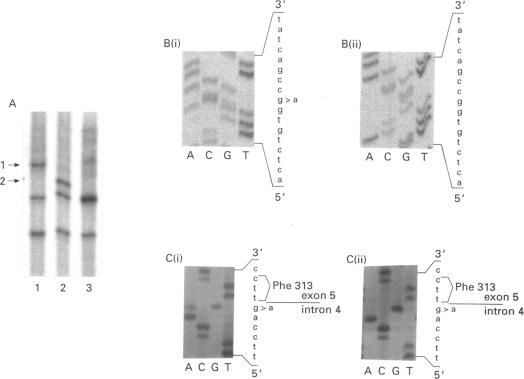
Retinitis pigmentosa (RP) is the name given to a group of disorders, both clinically and genetically heterogeneous, that primarily affect the photoreceptor function of the eye. Mutations in the genes encoding for rhodopsin, RDS-peripherin, or the beta subunit of the cGMP phosphodiesterase enzyme can be responsible for the phenotype. In this study the rhodopsin gene has been screened for mutations in a panel of RP individuals and five different sequence changes have been detected to date in three dominantly inherited and two unclassified families. One of these, a base substitution in the 3'UTR, has not yet been confirmed as disease specific, while three missense substitutions have previously been reported and are likely to be responsible for the phenotype. The fifth change, a base substitution at the intron 4 acceptor splice site, represents a novel mutation and is assumed to be the causative mutation.
视网膜色素变性(RP)是一组在临床和遗传上均具有异质性的疾病的统称,主要影响眼睛的光感受器功能。编码视紫红质、RDS-周边蛋白或cGMP磷酸二酯酶β亚基的基因突变可能导致该表型。在本研究中,对一组视网膜色素变性个体的视紫红质基因进行了突变筛查,迄今为止,在三个显性遗传家族和两个未分类家族中检测到了五种不同的序列变化。其中之一,3'非翻译区的一个碱基替换,尚未被确认为疾病特异性的,而之前已经报道了三个错义替换,它们可能是导致该表型的原因。第五个变化,内含子4受体剪接位点的一个碱基替换,代表一种新的突变,被认为是致病突变。