van Hoffen A, Venema J, Meschini R, van Zeeland A A, Mullenders L H
MGC, Department of Radiation Genetics, Leiden University, The Netherlands.
EMBO J. 1995 Jan 16;14(2):360-7. doi: 10.1002/j.1460-2075.1995.tb07010.x.
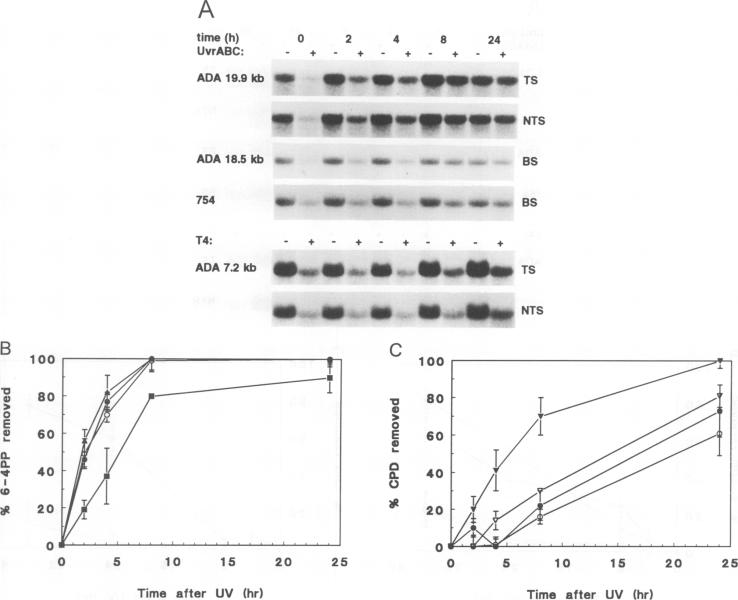
We investigated the contribution of the global and the transcription-coupled nucleotide excision repair pathway to the removal of structurally different DNA lesions. The repair kinetics of UV-induced cyclobutane pyrimidine dimers (CPDs) and pyrimidine (6-4) pyrimidone photoproducts (6-4PPs) were determined in an active and inactive gene in normal human fibroblasts and in xeroderma pigmentosum group C (XP-C) fibroblasts. Previously we have shown that in normal human cells exposed to a UV dose of 10 J/m2 repair of CPDs takes place via two pathways: global repair and transcription-coupled repair, the latter being responsible for accelerated repair of CPDs in the transcribed strand of active genes. So far, no clear evidence for transcription-coupled repair of 6-4PPs has been presented. Here we demonstrate that 6-4PPs really form a target for transcription-coupled repair. In XP-C cells, exposed to 30 J/m2 and only capable of performing transcription-coupled repair, CPDs as well as 6-4PPs are removed selectively and with similar kinetics from the transcribed strand of the adenosine deaminase (ADA) gene. The non-transcribed strand of the ADA gene and the inactive 754 gene are hardly repaired. In contrast to XP-C cells, normal cells exposed to 30 J/m2 lack strand-specific repair of both 6-4PPs and CPDs, suggesting that transcription-coupled repair is overruled by global repair, probably due to severe inhibition of transcription at this high UV dose. The much more rapid repair of 6-4PPs compared with CPDs in normal cells may be related to higher affinity of the global repair system for the former lesion. In XP-C cells the similarity of the rate of repair of both 6-4PPs and CPDs in the transcribed strand at 30 J/m2 indicates that transcription-coupled repair of photolesions takes place in a sequential way. Our results strongly suggest that the significance of transcription-coupled repair for removal of lesions depends on the type of lesion and on the dose employed.
我们研究了全局核苷酸切除修复途径和转录偶联核苷酸切除修复途径在去除结构不同的DNA损伤中的作用。在正常人成纤维细胞和着色性干皮病C组(XP-C)成纤维细胞的活性基因和非活性基因中,测定了紫外线诱导的环丁烷嘧啶二聚体(CPD)和嘧啶(6-4)嘧啶酮光产物(6-4PP)的修复动力学。此前我们已经表明,在暴露于10 J/m²紫外线剂量的正常人细胞中,CPD的修复通过两条途径进行:全局修复和转录偶联修复,后者负责加速活性基因转录链中CPD的修复。到目前为止,尚未有明确证据表明6-4PP存在转录偶联修复。在此我们证明,6-4PP确实是转录偶联修复的靶点。在暴露于30 J/m²且仅能进行转录偶联修复的XP-C细胞中,CPD和6-4PP从腺苷脱氨酶(ADA)基因的转录链中被选择性地去除,且动力学相似。ADA基因的非转录链和非活性的754基因几乎未被修复。与XP-C细胞不同,暴露于30 J/m²的正常细胞缺乏6-4PP和CPD的链特异性修复,这表明转录偶联修复被全局修复所取代,可能是由于在此高紫外线剂量下转录受到严重抑制。与正常细胞中的CPD相比,6-4PP修复速度更快可能与全局修复系统对前者损伤的更高亲和力有关。在XP-C细胞中,30 J/m²时转录链中6-4PP和CPD的修复速率相似,这表明光损伤的转录偶联修复以顺序方式进行。我们的结果强烈表明,转录偶联修复对损伤去除的重要性取决于损伤类型和所采用的剂量。