Munroe D J, Loebbert R, Bric E, Whitton T, Prawitt D, Vu D, Buckler A, Winterpacht A, Zabel B, Housman D E
Department of Biology, Massachusetts Institute of Technology, Cambridge 02139.
Proc Natl Acad Sci U S A. 1995 Mar 14;92(6):2209-13. doi: 10.1073/pnas.92.6.2209.
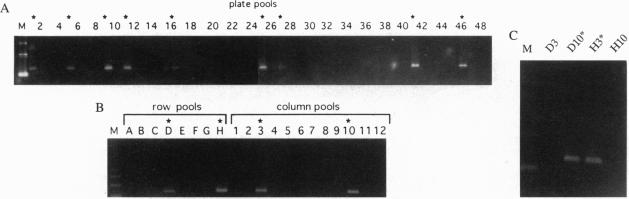
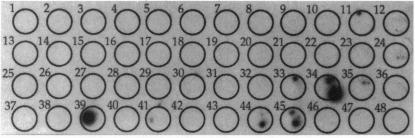
We have developed a PCR-based method for rapid and effective screening of arrayed cDNA libraries. This strategy directly addresses the limitations of conventional hybridization-based schemes and provides a more rapid, cost-effective, and sensitive method compatible with large-scale and routine cDNA clone recovery. To prepare arrayed libraries, 1-2 x 10(6) cDNA clones were propagated as individual plaques on solid medium in 24-well culture dishes at approximately 250 plaque-forming units per well. Phage suspensions were prepared from each well and transferred to a 96-well format. To screen the library, pools were generated that correspond to each individual 96-well plate and to each row and column within "blocks" of six plates each. Library screening for specific cDNA clones was conducted in a systematic and hierarchical fashion beginning with the plate pools. Next, the row/column pools corresponding to each positive plate pool were screened. Finally, isolated clones from within each positive well were identified by hybridization. We have applied this approach to the screening of an arrayed human brain cDNA library resulting in the recovery of cDNAs corresponding to > 25 genes and expressed sequence tags.
我们开发了一种基于聚合酶链反应(PCR)的方法,用于快速、有效地筛选阵列式cDNA文库。该策略直接解决了传统基于杂交方法的局限性,并提供了一种更快速、经济高效且灵敏的方法,适用于大规模和常规的cDNA克隆回收。为了制备阵列式文库,将1 - 2×10⁶个cDNA克隆作为单个噬菌斑在24孔培养板的固体培养基上进行培养,每孔约250个噬菌斑形成单位。从每孔制备噬菌体悬液并转移至96孔板中。为了筛选文库,生成了与每个单独的96孔板以及每个由六个板组成的“块”内的每行和每列相对应的混合样本。针对特定cDNA克隆的文库筛选从板混合样本开始,以系统且分层的方式进行。接下来,筛选与每个阳性板混合样本相对应的行/列混合样本。最后,通过杂交鉴定每个阳性孔内的单个克隆。我们已将此方法应用于筛选阵列式人类脑cDNA文库,从而获得了对应于超过25个基因和表达序列标签的cDNA。