Hatta K, Püschel A W, Kimmel C B
Institute of Neuroscience, University of Oregon, Eugene 97403.
Proc Natl Acad Sci U S A. 1994 Mar 15;91(6):2061-5. doi: 10.1073/pnas.91.6.2061.
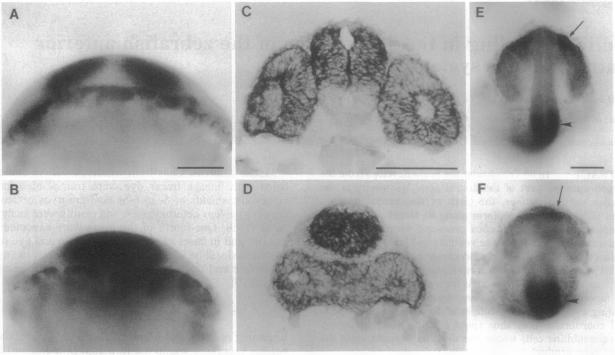
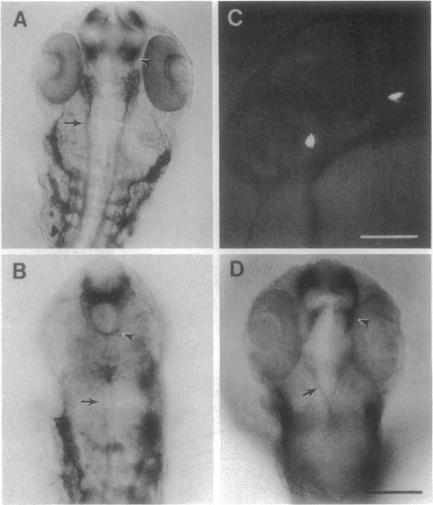
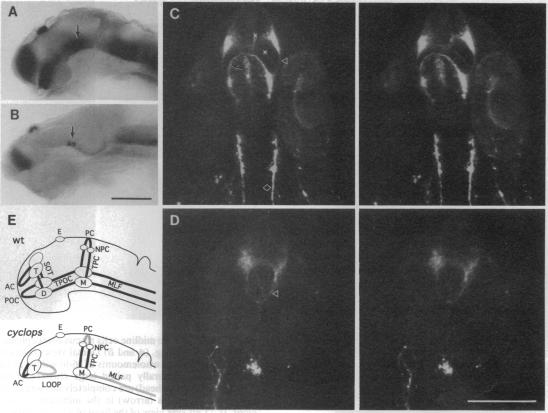
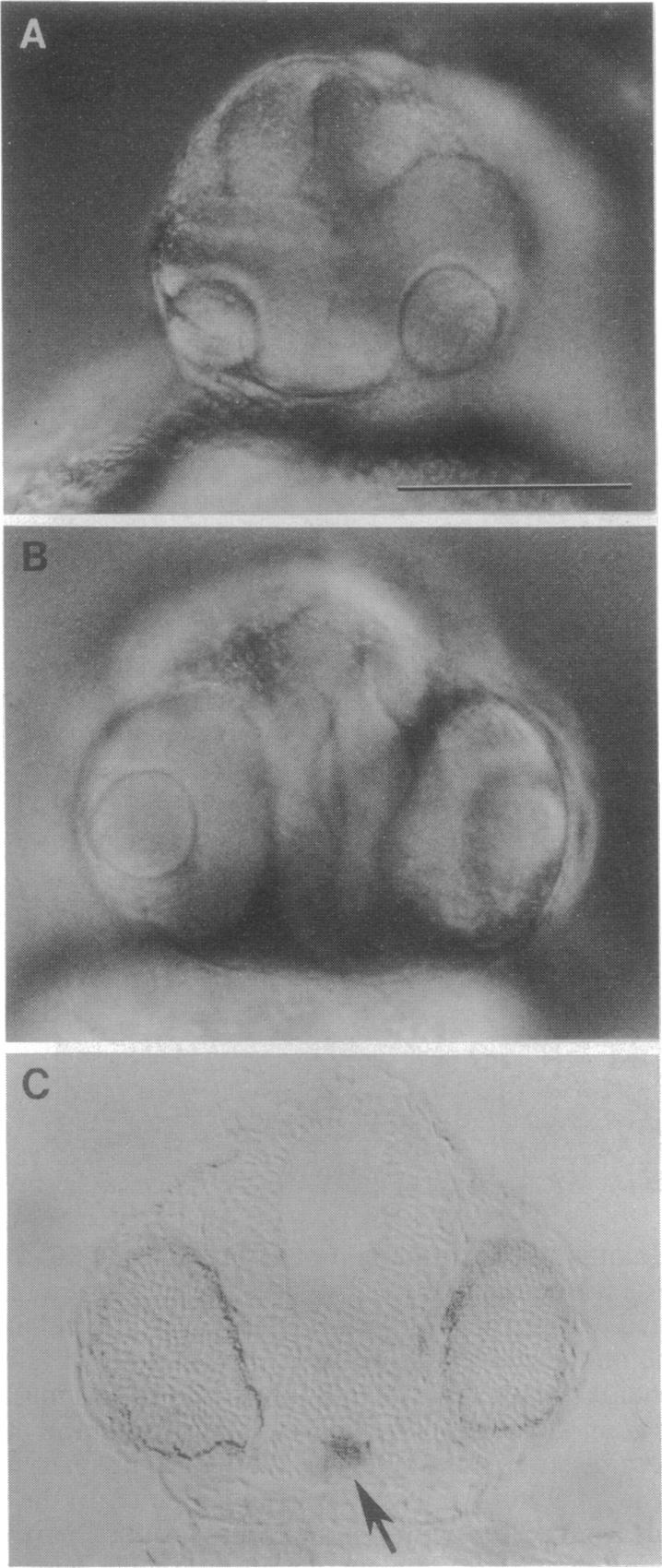
In all vertebrates the brain develops from the enlarged anterior part of the neural plate. However, in the zebrafish mutant cyclops, the girth of the central nervous system (CNS) is nearly uniform along its length. Changes in expression patterns of homeobox genes and neuronal markers reveal a massive deletion of the ventral forebrain, particularly the diencephalon, as well as its precursor region in the neural plate. The deletion is due to a nonautonomous action of the mutation: very few wild-type cells transplanted to the midline of a mutant embryo can rescue the forebrain phenotype, including cyclopia. Establishment of forebrain ventral positional coordinates may thus require inductive signaling by forebrain midline cells whose specification depends upon the cyclops gene product.
在所有脊椎动物中,大脑都由神经板前端的扩大部分发育而来。然而,在斑马鱼突变体“独眼”中,中枢神经系统(CNS)的周长沿其长度几乎是均匀的。同源框基因和神经元标记物表达模式的变化揭示了腹侧前脑,特别是间脑及其在神经板中的前体区域的大量缺失。这种缺失是由于突变的非自主作用:移植到突变胚胎中线的野生型细胞很少能挽救前脑表型,包括独眼畸形。因此,前脑腹侧位置坐标的建立可能需要前脑中线细胞的诱导信号,而这些细胞的特化依赖于“独眼”基因产物。