Smith N C, Wallach M, Miller C M, Braun R, Eckert J
Institut für Parasitologie, Universität Zürich, Switzerland.
Infect Immun. 1994 Nov;62(11):4811-7. doi: 10.1128/iai.62.11.4811-4817.1994.
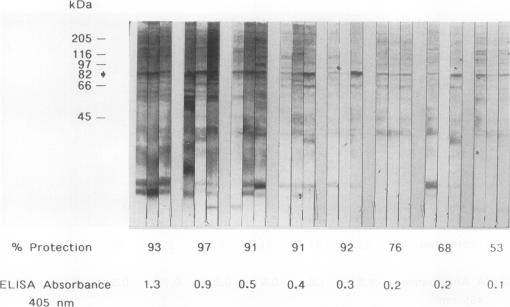
Infection of breeding hens with Eimeria maxima induces production of parasite-specific antibodies which are transferred, via the egg yolk, to hatchling chicks. These antibodies (immunoglobulin G) are highly protective, mediating up to a 97% reduction in oocyst excretion in challenged hatchlings. However, the degree of maternally derived immunity transferred by the hens to their offspring declines with increasing time after infection of the hens. This decline in immunity is directly related to declining immunoglobulin G titers. However, sera from highly protected hatchlings recognize only a very few E. maxima proteins on Western blots (immunoblots). In particular, a 230-kDa protein band is outstanding for its association with maternally derived immunity to E. maxima in hatchlings. This band was excised from a sodium dodecyl sulfate-polyacrylamide gel electrophoresis (SDS-PAGE) preparative gel of crude merozoite protein extract. The SDS-PAGE cutout was emulsified in Freund's adjuvant and injected, intramuscularly, into six breeding hens on two occasions, 2 weeks apart. Eggs were collected from these hens 28 to 39 days after the second injection, and the hatchlings from these eggs were challenged with 150 sporulated oocysts of E. maxima. Subsequent oocyst excretion in these hatchlings was, on average, 54% lower than oocyst excretion by control chicks but only 37% lower (significant at P < 0.05) than that by chicks from hens sham immunized with Freund's adjuvant. The latter result is apparently due to the ability of the adjuvant to induce production of antibodies which recognize Eimeria spp. and thereby transfer some degree of protection to hatchlings. These experiments indicate that protective, maternally derived immunoglobulin G antibodies may be useful for the identification of putative anticoccidial vaccine candidates.
用巨型艾美耳球虫感染种母鸡可诱导产生寄生虫特异性抗体,这些抗体通过蛋黄传递给雏鸡。这些抗体(免疫球蛋白G)具有高度保护作用,可使受攻击的雏鸡卵囊排泄量减少多达97%。然而,母鸡传给后代的母源免疫力程度会随着母鸡感染后时间的增加而下降。这种免疫力的下降与免疫球蛋白G滴度的下降直接相关。然而,来自高度受保护雏鸡的血清在蛋白质免疫印迹(免疫印迹)中只能识别极少数巨型艾美耳球虫蛋白。特别是,一条230 kDa的蛋白带因其与雏鸡对巨型艾美耳球虫的母源免疫力相关而格外突出。这条带从裂殖子蛋白粗提物的十二烷基硫酸钠-聚丙烯酰胺凝胶电泳(SDS-PAGE)制备凝胶上切下。将SDS-PAGE切下的条带在弗氏佐剂中乳化,分两次(间隔2周)肌肉注射到6只种母鸡体内。在第二次注射后28至39天从这些母鸡收集鸡蛋,用150个巨型艾美耳球虫孢子化卵囊攻击这些鸡蛋孵出的雏鸡。这些雏鸡随后的卵囊排泄量平均比对照雏鸡低54%,但仅比用弗氏佐剂进行假免疫的母鸡所孵出雏鸡低37%(P<0.05时有显著性差异)。后一结果显然是由于佐剂诱导产生了能识别艾美耳属球虫的抗体,从而为雏鸡传递了一定程度的保护。这些实验表明,具有保护作用的母源免疫球蛋白G抗体可能有助于鉴定潜在的抗球虫疫苗候选物。