Arora N, Leppla S H
Laboratory of Microbial Ecology, National Institute of Dental Research, Bethesda, Maryland 20892.
Infect Immun. 1994 Nov;62(11):4955-61. doi: 10.1128/iai.62.11.4955-4961.1994.
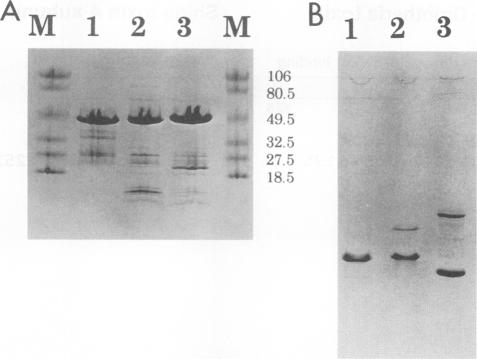
To investigate the ability of anthrax toxin lethal factor (LF) to translocate foreign proteins into the cytosol of eukaryotic cells and to characterize the structural requirements of this process, fusion proteins containing a portion of LF and the catalytic domains of either diphtheria toxin or Shiga toxin were constructed. Previous work showed that residues 1 to 254 of anthrax toxin lethal factor (LF1-254) are sufficient for binding to the protective antigen component of the toxin and that portions of Pseudomonas exotoxin A fused to LF1-254 are efficiently translocated to the cytosol of eukaryotic cells (N. Arora and S. H. Leppla, J. Biol. Chem. 268:3334-3341, 1993). In this study, it was found that fusion proteins containing the ADP-ribosylation domain of diphtheria toxin fused at either the amino end or the carboxyl end of LF1-254 are highly toxic to Chinese hamster ovary (CHO) cells, indicating that translocation does not strictly require that the amino terminus of LF be free. A fusion protein containing the ribosome-inactivating A1 subunit of Shiga toxin fused to the carboxyl terminus of LF1-254 was also highly toxic for CHO cells. All fusion proteins were toxic only when administered with the anthrax toxin protective antigen component. The data show that the combination of protective antigen and LF fusion proteins can efficiently import polypeptides from diverse bacterial sources to the cytosol of eukaryotic cells and that LF fusion proteins may have the passenger polypeptides fused at either the amino terminus or the carboxyl terminus of LF1-254. These LF fusion proteins could potentially be used as components of a therapeutic agent when the destruction of certain types of cells is desired (e.g., in treating cancer).
为了研究炭疽毒素致死因子(LF)将外源蛋白转运到真核细胞胞质溶胶中的能力,并确定该过程的结构要求,构建了包含部分LF以及白喉毒素或志贺毒素催化结构域的融合蛋白。先前的研究表明,炭疽毒素致死因子的第1至254位残基(LF1-254)足以与毒素的保护性抗原成分结合,并且与LF1-254融合的铜绿假单胞菌外毒素A的部分能够有效地转运到真核细胞的胞质溶胶中(N. Arora和S. H. Leppla,《生物化学杂志》268:3334 - 3341,1993)。在本研究中,发现包含白喉毒素ADP - 核糖基化结构域且融合在LF1-254氨基端或羧基端的融合蛋白对中国仓鼠卵巢(CHO)细胞具有高毒性,这表明转运并不严格要求LF的氨基端是游离的。包含与LF1-254羧基端融合的志贺毒素核糖体失活A1亚基的融合蛋白对CHO细胞也具有高毒性。所有融合蛋白仅在与炭疽毒素保护性抗原成分一起给药时才具有毒性。数据表明,保护性抗原和LF融合蛋白的组合能够有效地将来自不同细菌来源的多肽导入真核细胞的胞质溶胶中,并且LF融合蛋白的乘客多肽可以融合在LF1-254的氨基端或羧基端。当需要破坏某些类型的细胞时(例如在治疗癌症时),这些LF融合蛋白有可能用作治疗剂的成分。