Friedlander A M, Bhatnagar R, Leppla S H, Johnson L, Singh Y
U.S. Army Medical Research Institute of Infectious Diseases, Frederick, Maryland 21702-5011.
Infect Immun. 1993 Jan;61(1):245-52. doi: 10.1128/iai.61.1.245-252.1993.
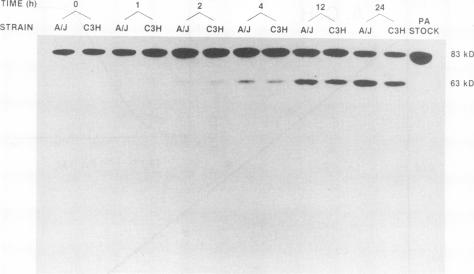
Anthrax lethal toxin, which consists of two proteins, protective antigen and lethal factor, is cytolytic for macrophages. Macrophages from different mouse strains were found to vary in their sensitivities to toxin. C3H mouse macrophages lysed by lethal factor concentrations of 0.001 micrograms/ml were 100,000 times more sensitive than those from resistant A/J mice. We analyzed various stages of the intoxication process to determine the basis for this resistance. Direct binding studies with radioiodinated protective antigen revealed that the affinity (Kd, approximately 0.5 nM) and number of receptors per cell (25,000 to 33,000) were the same in sensitive and resistant cells. Proteolytic activation of protective antigen by a cell surface protease and subsequent binding of lethal factor were also the same in both sensitive and resistant macrophages. Resistant A/J macrophages were not cross-resistant to other toxins and a virus which, like lethal toxin, require vesicular acidification for activity, implying that resistance is not due to a defect in vesicular acidification. When introduced into the cytosol by osmotic lysis of pinosomes, lethal factor in the absence of protective antigen was cytolytic for the sensitive macrophages while resistant cells were unaffected. Thus, lethal factor by itself possesses the toxic activity of lethal toxin. These results suggest that macrophage resistance is due to a defect at a stage occurring after toxin internalization. A/J macrophages may lack the putative lethal factor target in the cytosol or be defective in the further processing or activation of lethal factor in the cytosol or in endocytic vesicles.
炭疽致死毒素由两种蛋白质即保护性抗原和致死因子组成,对巨噬细胞具有细胞溶解作用。研究发现,来自不同小鼠品系的巨噬细胞对毒素的敏感性存在差异。被浓度为0.001微克/毫升的致死因子裂解的C3H小鼠巨噬细胞比抗性A/J小鼠的巨噬细胞敏感性高100,000倍。我们分析了中毒过程的各个阶段,以确定这种抗性的基础。用放射性碘化保护性抗原进行的直接结合研究表明,敏感细胞和抗性细胞的亲和力(解离常数Kd,约0.5纳摩尔)和每个细胞的受体数量(25,000至33,000)是相同的。细胞表面蛋白酶对保护性抗原的蛋白水解激活以及随后致死因子的结合在敏感和抗性巨噬细胞中也相同。抗性A/J巨噬细胞对其他毒素和一种病毒没有交叉抗性,这种病毒与致死毒素一样,需要囊泡酸化才能发挥活性,这意味着抗性不是由于囊泡酸化缺陷所致。当通过吞噬体的渗透裂解将其引入胞质溶胶时,在没有保护性抗原的情况下,致死因子对敏感巨噬细胞具有细胞溶解作用,而抗性细胞则不受影响。因此,致死因子本身具有致死毒素的毒性活性。这些结果表明,巨噬细胞抗性是由于毒素内化后发生的一个阶段存在缺陷所致。A/J巨噬细胞可能在胞质溶胶中缺乏假定的致死因子靶标,或者在胞质溶胶或内吞小泡中致死因子的进一步加工或激活存在缺陷。