Cvekl A, Sax C M, Bresnick E H, Piatigorsky J
Laboratory of Molecular and Developmental Biology, National Eye Institute, National Institutes of Health, Bethesda, Maryland 20892-2730.
Mol Cell Biol. 1994 Nov;14(11):7363-76. doi: 10.1128/mcb.14.11.7363-7376.1994.
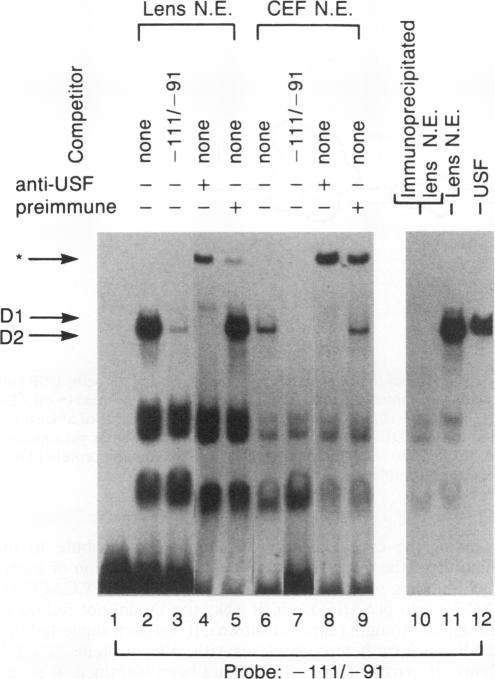
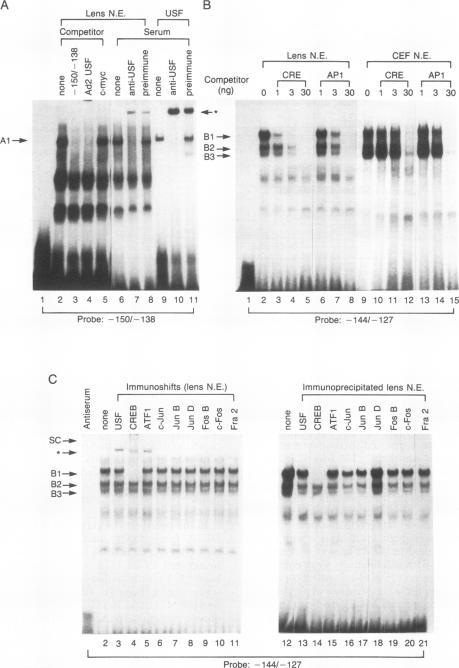
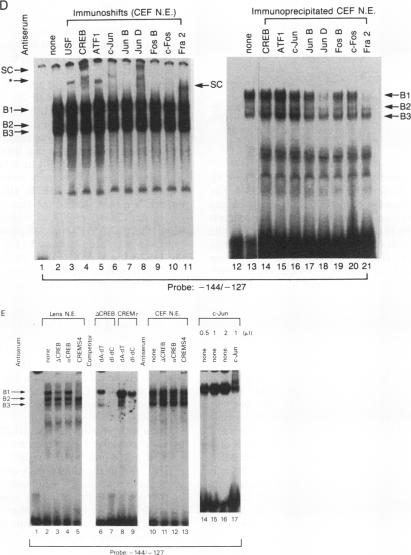
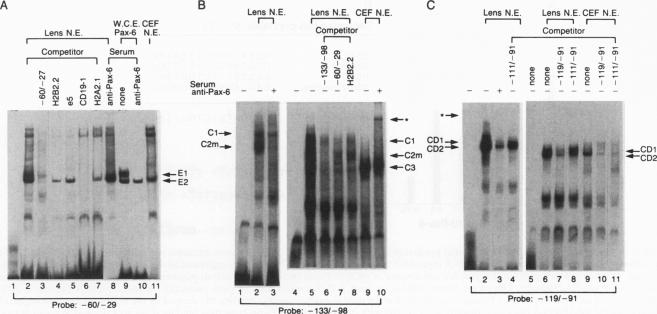
The abundance of crystallins (> 80% of the soluble protein) in the ocular lens provides advantageous markers for selective gene expression during cellular differentiation. Here we show by functional and protein-DNA binding experiments that the chicken alpha A-crystallin gene is regulated by at least five control elements located at sites A (-148 to -139), B (-138 to -132), C (-128 to -101), D (-102 to -93), and E (-56 to -41). Factors interacting with these sites were characterized immunologically and by gel mobility shift experiments. The results are interpreted with the following model. Site A binds USF and is part of a composite element with site B. Site B binds CREB and/or CREM to enhance expression in the lens and binds an AP-1 complex including CREB, Fra2 and/or JunD which interacts with USF on site A to repress expression in fibroblasts. Sites C and E (which is conserved across species) bind Pax-6 in the lens to stimulate alpha A-crystallin promoter activity. These experiments provide the first direct data that Pax-6 contributes to the lens-specific expression of a crystallin gene. Site D (-104 to -93) binds USF and is a negative element. Thus, the data indicate that USF, CREB and/or CREM (or AP-1 factors), and Pax-6 bind a complex array of positive and negative cis-acting elements of the chicken alpha A-crystallin gene to control high expression in the lens and repression in fibroblasts.
晶状体中大量存在的晶状体蛋白(占可溶性蛋白的80%以上)为细胞分化过程中的选择性基因表达提供了有利的标记。在此,我们通过功能和蛋白质-DNA结合实验表明,鸡αA-晶状体蛋白基因受至少五个位于A位点(-148至-139)、B位点(-138至-132)、C位点(-128至-101)、D位点(-102至-93)和E位点(-56至-41)的调控元件控制。通过免疫和凝胶迁移率变动实验对与这些位点相互作用的因子进行了表征。结果用以下模型进行解释。A位点结合USF,是与B位点组成的复合元件的一部分。B位点结合CREB和/或CREM以增强晶状体中的表达,并结合包括CREB、Fra2和/或JunD的AP-1复合物,该复合物与A位点上的USF相互作用以抑制成纤维细胞中的表达。C位点和E位点(在物种间保守)在晶状体中结合Pax-6以刺激αA-晶状体蛋白启动子活性。这些实验提供了首个直接数据,表明Pax-6有助于晶状体蛋白基因的晶状体特异性表达。D位点(-104至-93)结合USF,是一个负调控元件。因此,数据表明USF、CREB和/或CREM(或AP-1因子)以及Pax-6结合鸡αA-晶状体蛋白基因一系列正负顺式作用元件,以控制晶状体中的高表达和成纤维细胞中的抑制。