Lillycrop K A, Dawson S J, Estridge J K, Gerster T, Matthias P, Latchman D S
Department of Molecular Pathology, University College London Medical School, United Kingdom.
Mol Cell Biol. 1994 Nov;14(11):7633-42. doi: 10.1128/mcb.14.11.7633-7642.1994.
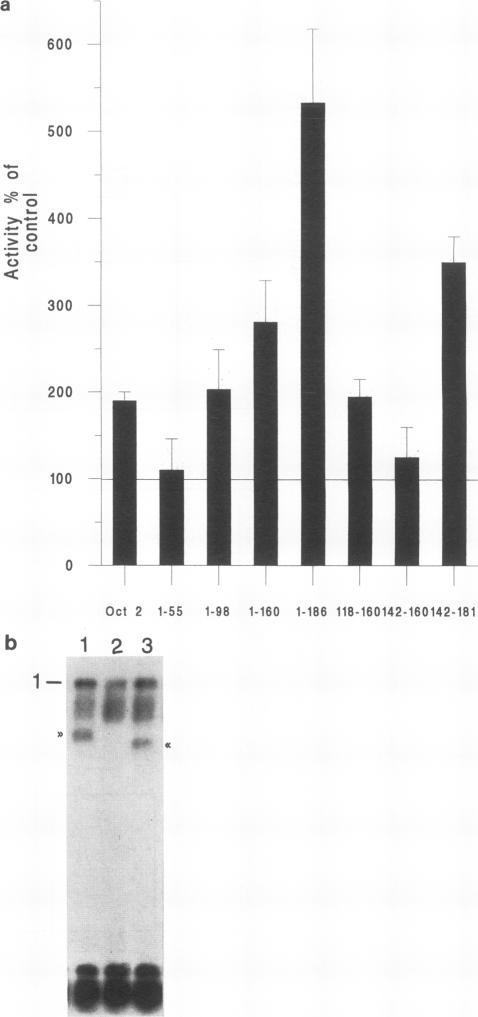
The B-cell form of the Oct-2 transcription factor Oct 2.1 can activate the herpes simplex virus immediate-early gene 3 (IE3) promoter, whereas the neuronally expressed Oct 2.4 and 2.5 forms of the protein, which contain a different C terminus, can repress this promoter. Here we show that partial or full deletion of the C terminus of Oct 2.1 in the presence of an intact N terminus results in a protein which can strongly repress the IE3 promoter. In contrast, deletion of the entire N terminus or a short region within it leaving the C terminus intact results in a very strong activator. Deletion of both N and C termini leaving only the isolated POU domain generates only a very weak repressor. The N-terminal region defined in this way can repress a heterologous promoter when linked to the DNA-binding domain of the GAL4 factor, indicating that it can function as an independent inhibitory domain. These results indicate that a specific region within the N terminus common to Oct 2.1, 2.4, and 2.5 plays a critical role in the ability of neuronally expressed forms of Oct-2 to repress the IE3 promoter but can do so only when the C-terminal region of Oct 2.1 is altered or deleted.
Oct-2转录因子的B细胞形式Oct 2.1能够激活单纯疱疹病毒立即早期基因3(IE3)启动子,而神经元中表达的Oct 2.4和2.5形式的该蛋白(它们含有不同的C末端)则能够抑制此启动子。在此我们表明,在完整的N末端存在的情况下,Oct 2.1的C末端部分或完全缺失会产生一种能够强烈抑制IE3启动子的蛋白。相反,整个N末端或其中一个短区域缺失而C末端保持完整会产生一个非常强的激活剂。N末端和C末端都缺失仅留下分离的POU结构域时仅产生一个非常弱的抑制剂。以这种方式定义的N末端区域与GAL4因子的DNA结合结构域相连时能够抑制一个异源启动子,这表明它能够作为一个独立的抑制结构域发挥作用。这些结果表明,Oct 2.1、2.4和2.5共有的N末端内的一个特定区域在神经元表达形式的Oct-2抑制IE3启动子的能力中起关键作用,但只有在Oct 2.1的C末端区域改变或缺失时才能如此。