Gratiot-Deans J, Merino R, Nuñez G, Turka L A
Department of Internal Medicine, University of Michigan, Ann Arbor 48109.
Proc Natl Acad Sci U S A. 1994 Oct 25;91(22):10685-9. doi: 10.1073/pnas.91.22.10685.
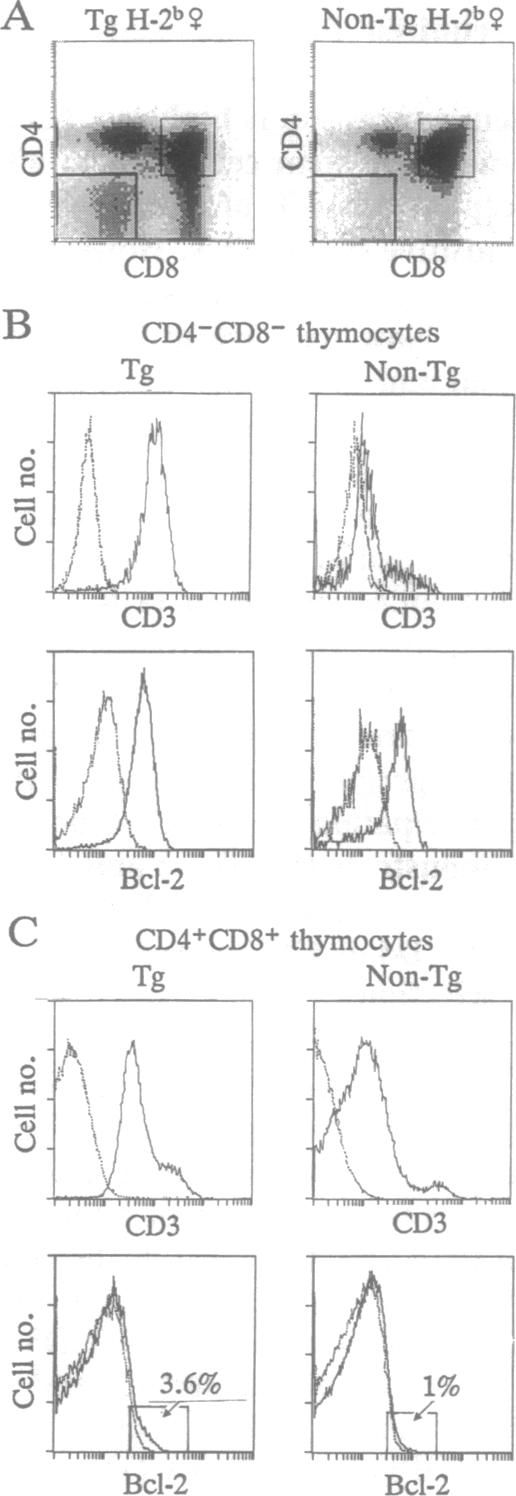
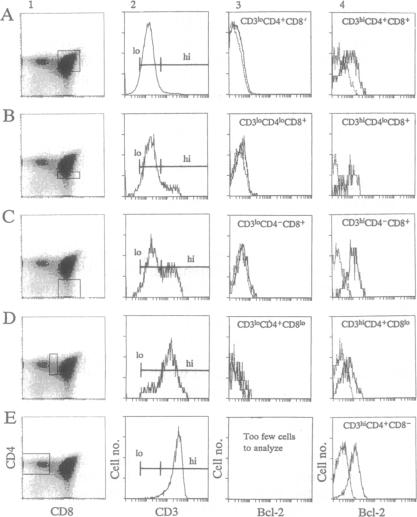
During T-cell development CD3-CD4-CD8- (double-negative) thymocytes proliferative and produce an enormous number of CD3loCD4+CD8+ (double-positive) thymocytes which are destined to die intrathymically unless rescued by positive selection. Those which survive become mature CD3hiCD4/8+ (single-positive) cells and are the precursor of peripheral blood lymphocytes. The product of the bcl-2 protooncogene has been implicated in preventing programmed cell death and is required for prolonged lymphocyte survival following maturation. Previously we and others have reported that Bcl-2 protein expression is biphasic, being high in proliferating double-negative stem cells, low in all double-positive thymocytes except for 1-5% of these cells, and restored in mature, single-positive thymocytes. However, it remained unclear which signaling and selection events regulate Bcl-2 during T-cell maturation. Now we have utilized four-color flow cytometry in normal and genetically altered mice for a detailed analysis of Bcl-2 expression as it relates to T-cell receptor (TCR) expression and positive selection. These studies show that (i) expression of a transgenic TCR in double-negative thymocytes does not lead to premature loss of Bcl-2; thus, Bcl-2 downregulation is not solely due to TCR expression; (ii) Bcl-2 expression is lost at the early transitional CD3-/loCD4-CD8+ stage, prior to expression of CD4; (iii) the Bcl-2+ double-positive thymocytes are those which have undergone positive selection; and (iv) upregulation of Bcl-2 during positive selection requires participation of the CD4 or CD8 co-receptor. These results demonstrate that Bcl-2 and TCR expression are regulated independently during T-cell development, and suggest a role for the CD4 or CD8 co-receptor in Bcl-2 induction during positive selection.
在T细胞发育过程中,CD3-CD4-CD8-(双阴性)胸腺细胞进行增殖并产生大量CD3loCD4+CD8+(双阳性)胸腺细胞,这些双阳性胸腺细胞除非通过阳性选择得以拯救,否则注定会在胸腺内死亡。那些存活下来的细胞会成为成熟的CD3hiCD4/8+(单阳性)细胞,它们是外周血淋巴细胞的前体。bcl-2原癌基因的产物与预防程序性细胞死亡有关,并且是成熟后淋巴细胞长期存活所必需的。此前我们和其他人曾报道,Bcl-2蛋白表达呈双相性,在增殖的双阴性干细胞中表达较高,在所有双阳性胸腺细胞中除了1%-5%的细胞外表达较低,而在成熟的单阳性胸腺细胞中表达恢复。然而,尚不清楚在T细胞成熟过程中哪些信号传导和选择事件调节Bcl-2。现在我们利用四色流式细胞术在正常和基因改变的小鼠中详细分析了与T细胞受体(TCR)表达和阳性选择相关的Bcl-2表达。这些研究表明:(i)在双阴性胸腺细胞中表达转基因TCR不会导致Bcl-2过早丢失;因此,Bcl-2下调并非仅由TCR表达所致;(ii)在CD4表达之前的早期过渡性CD3-/loCD4-CD8+阶段,Bcl-2表达丢失;(iii)Bcl-2+双阳性胸腺细胞是那些已经经历阳性选择的细胞;(iv)阳性选择过程中Bcl-2的上调需要CD4或CD8共受体的参与。这些结果表明,在T细胞发育过程中Bcl-2和TCR表达是独立调节的,并提示CD4或CD8共受体在阳性选择过程中Bcl-2诱导中发挥作用。