Sargeant J M, Blackwell T E, Martin S W, Tremblay R R
Department of Population Medicine, Ontario Veterinary College, University of Guelph.
Can J Vet Res. 1994 Jul;58(3):189-95.
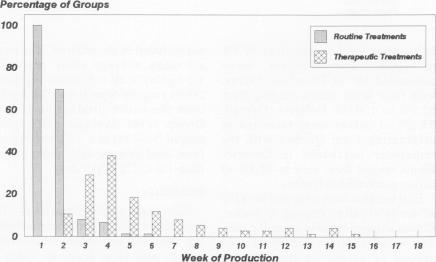
A group of 4863 white veal calves reared on six commercial white veal farms in Ontario were followed through production to describe calf characteristics and production levels. Patterns of morbidity, mortality, and culling were investigated at the farm, room and individual level. The majority of the calves were male Holsteins, with approximately half originating from Ontario. The mean average daily gain for shipped calves over the entire production period was 1.1 kg/day (SE = 0.002). The overall percentage of calves receiving at least one individual treatment was 59%, with an average number of treatment days per calf of 3.3. The majority of calves receiving one or more treatment days were first treated between the fourth and seventh week of production. The mortality rate was 3.7%, and 5.1% of the calves were culled. Pneumonia was the largest single cause of death. Peak death and cull losses occurred during the seventh and eighth week of production.
对安大略省六个商业白犊牛养殖场饲养的4863头白色小牛肉犊牛进行了跟踪记录,以描述犊牛的特征和生产水平。在农场、畜舍和个体层面调查了发病、死亡和淘汰模式。大多数犊牛是雄性荷斯坦牛,约一半来自安大略省。整个生产期内运输出的犊牛平均日增重为1.1千克/天(标准误=0.002)。至少接受过一次个体治疗的犊牛总体比例为59%,每头犊牛的平均治疗天数为3.3天。大多数接受过一个或多个治疗日的犊牛在生产的第四至第七周首次接受治疗。死亡率为3.7%,5.1%的犊牛被淘汰。肺炎是最大的单一死因。死亡和淘汰损失高峰出现在生产的第七和第八周。