Yasumoto K, Yokoyama K, Shibata K, Tomita Y, Shibahara S
Department of Applied Physiology and Molecular Biology, Tohoku University School of Medicine, Miyagi, Japan.
Mol Cell Biol. 1994 Dec;14(12):8058-70. doi: 10.1128/mcb.14.12.8058-8070.1994.
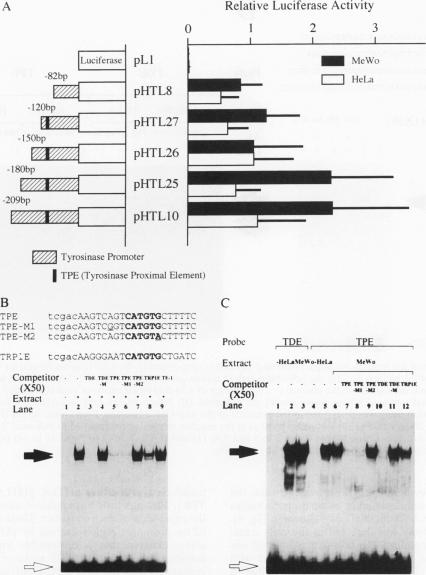
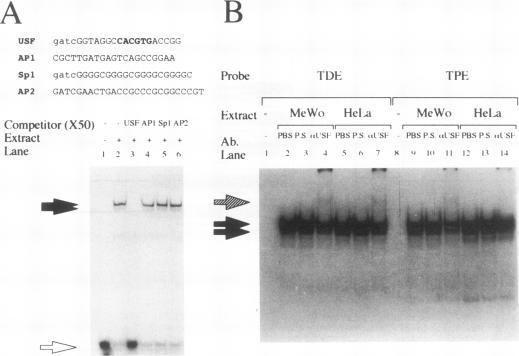
Tyrosinase is a rate-limiting enzyme in melanin biosynthesis and is specifically expressed in differentiated melanocytes. We have identified the enhancer element in the 5'-flanking region of the human tyrosinase gene that is responsible for its pigment cell-specific transcription and have termed it tyrosinase distal element (TDE) (positions -1861 to -1842). Transient expression assays showed that TDE confers efficient expression of a firefly luciferase reporter gene linked to the tyrosinase gene promoter in MeWo pigmented melanoma cells but not in HeLa cells, which do not express tyrosinase. TDE was specifically bound by nuclear proteins of MeWo and HeLa cells, the binding properties of which were indistinguishable in gel mobility shift assays. TDE contains the CATGTG motif in its center, and mutation analysis indicates that the CA dinucleotides of this motif are crucial for protein binding and pigment cell-specific enhancer function. The CATGTG motif is consistent with the consensus sequence recognized by a large family of transcription factors with a basic helix-loop-helix structure, which prompted us to examine the possible involvement of a ubiquitous transcription factor, USF, and a novel factor, microphthalmia-associated transcription factor (MITF), recently cloned as the human homolog of the mouse microphthalmia (mi) gene product. The mi phenotype is associated with a mutant mi locus and characterized by small eyes and loss of melanin pigments. Both USF and MITF are predicted to contain a basic helix-loop-helix structure and a leucine zipper structure. We provide evidence that USF binds to TDE, whereas we were unable to detect the DNA-binding activity of MITF. Transient coexpression assays showed that MITF specifically transactivates the promoter activity of the tyrosinase gene through the CATGTG motif of TDE but not the promoter of the ubiquitously expressed heme oxygenase gene, while USF is able to activate both promoters. These results indicate that MITF is a cell-type-specific factor that is capable of activating transcription of the tyrosinase gene.
酪氨酸酶是黑色素生物合成中的一种限速酶,在分化的黑素细胞中特异性表达。我们已经在人酪氨酸酶基因的5'侧翼区域鉴定出负责其色素细胞特异性转录的增强子元件,并将其命名为酪氨酸酶远端元件(TDE)(位置-1861至-1842)。瞬时表达分析表明,TDE可使与酪氨酸酶基因启动子相连的萤火虫荧光素酶报告基因在MeWo色素性黑色素瘤细胞中高效表达,但在不表达酪氨酸酶的HeLa细胞中则不能。TDE与MeWo和HeLa细胞的核蛋白特异性结合,在凝胶迁移率变动分析中其结合特性没有差异。TDE在其中心含有CATGTG基序,突变分析表明该基序的CA二核苷酸对于蛋白质结合和色素细胞特异性增强子功能至关重要。CATGTG基序与具有基本螺旋-环-螺旋结构的一大类转录因子识别的共有序列一致,这促使我们研究普遍存在的转录因子USF以及最近作为小鼠小眼(mi)基因产物的人类同源物克隆的新因子小眼相关转录因子(MITF)可能的参与情况。mi表型与突变的mi基因座相关,其特征是眼睛小和黑色素色素缺失。USF和MITF预计都含有基本螺旋-环-螺旋结构和亮氨酸拉链结构。我们提供的证据表明USF与TDE结合,而我们无法检测到MITF的DNA结合活性。瞬时共表达分析表明,MITF通过TDE的CATGTG基序特异性地反式激活酪氨酸酶基因的启动子活性,但不能激活普遍表达的血红素加氧酶基因的启动子,而USF能够激活这两个启动子。这些结果表明,MITF是一种能够激活酪氨酸酶基因转录的细胞类型特异性因子。