Prusiner S B
Department of Neurology, University of California, San Francisco, School of Medicine 94143-0518.
West J Med. 1994 Sep;161(3):264-72.
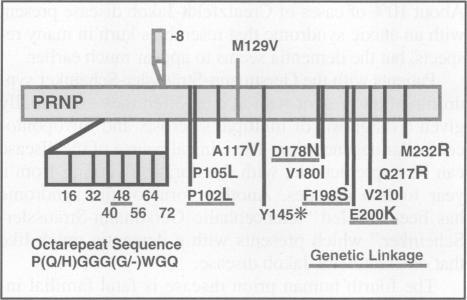
Prion diseases include kuru, Creutzfeldt-Jakob disease, Gerstmann-Sträussler-Scheinker disease, and fatal familial insomnia of humans as well as scrapie and bovine spongiform encephalopathy of animals. For many years, the prion diseases were thought to be caused by viruses despite evidence to the contrary. The unique characteristic common to all of these disorders, whether sporadic, dominantly inherited, or acquired by infection, is that they involve aberrant metabolism of the prion protein. In many cases, the cellular prion protein is converted into the scrapie variant by a process after translation that involves a conformational change. Often the human prion diseases are transmissible experimentally to animals, and all of the inherited prion diseases segregate with prion protein gene mutations.
朊病毒疾病包括人类的库鲁病、克雅氏病、格斯特曼-施特劳斯勒-谢inker病和致死性家族性失眠症,以及动物的羊瘙痒症和牛海绵状脑病。多年来,尽管有相反的证据,但朊病毒疾病一直被认为是由病毒引起的。所有这些疾病,无论是散发性、显性遗传性还是通过感染获得的,其共同的独特特征是它们都涉及朊病毒蛋白的异常代谢。在许多情况下,细胞朊病毒蛋白在翻译后通过一个涉及构象变化的过程转化为羊瘙痒症变体。人类朊病毒疾病通常可通过实验传播给动物,并且所有遗传性朊病毒疾病都与朊病毒蛋白基因突变相关。