Wisniewski T, Castaño E M, Golabek A, Vogel T, Frangione B
Department of Pathology, New York University Medical Center, NY 10016.
Am J Pathol. 1994 Nov;145(5):1030-5.
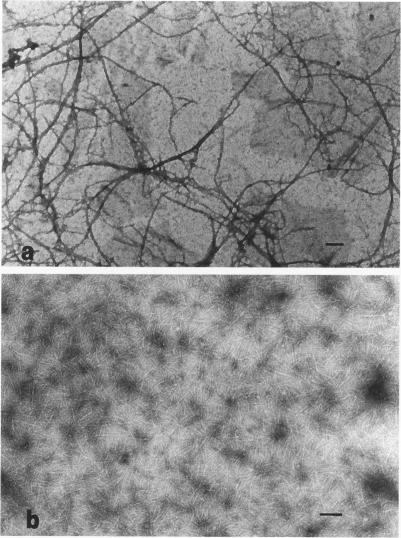
Numerous studies have established a linkage between the apolipoprotein (apo) E4 allele and late-onset Alzheimer's disease. It remains unclear if apo E plays a direct role in the pathogenesis of Alzheimer's disease and what, if any, are its significant interactions with amyloid beta (A beta) and tau. Apo E has been found immunohistochemically in all types of amyloid deposits and apo E fragments have been isolated from amyloid. Furthermore, apo E has been shown to bind soluble A beta. It has been proposed that apo E acts to promote and/or modulate A beta fibril formation. It is well established that peptides homologous to A beta will form amyloid-like fibrils in solution. With the use of electron microscopy and a thioflavin T assay for fibril formation we found that apo E and apo E4 in particular enhance this spontaneous fibrillogenesis of A beta peptides under the in vitro conditions used. These in vitro data suggest that the apo E4 isoform is a risk factor for Alzheimer's disease that acts to accelerate a process that can occur in its absence.
大量研究已证实载脂蛋白(apo)E4等位基因与晚发型阿尔茨海默病之间存在联系。目前尚不清楚载脂蛋白E是否在阿尔茨海默病的发病机制中起直接作用,以及它与β淀粉样蛋白(Aβ)和tau蛋白之间是否存在显著相互作用(若有)。免疫组织化学研究发现载脂蛋白E存在于所有类型的淀粉样沉积物中,且已从淀粉样物质中分离出载脂蛋白E片段。此外,研究表明载脂蛋白E能结合可溶性Aβ。有人提出载脂蛋白E可促进和/或调节Aβ纤维的形成。众所周知,与Aβ同源的肽段在溶液中会形成淀粉样纤维。通过电子显微镜和用于纤维形成的硫黄素T检测,我们发现在所用的体外条件下,载脂蛋白E尤其是载脂蛋白E4会增强Aβ肽的这种自发纤维形成过程。这些体外数据表明,载脂蛋白E4亚型是阿尔茨海默病的一个危险因素,其作用是加速一个在没有它时也可能发生的过程。