Pyles R B, Thompson R L
Department of Molecular Genetics, Biochemistry and Microbiology, College of Medicine, University of Cincinnati, Ohio 45267-0524.
J Virol. 1994 Aug;68(8):4963-72. doi: 10.1128/JVI.68.8.4963-4972.1994.
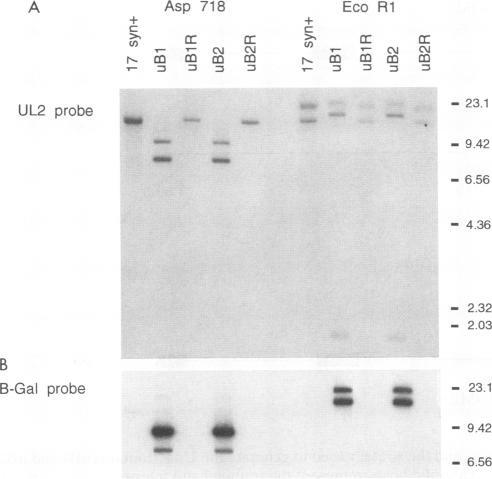
Herpes simplex virus (HSV) encodes a uracil DNA glycosylase (UNG; UL2), which has been shown to be dispensable for normal replication of HSV-1 in cultured cells (J. Mullaney, H.W. Moss, and D.J. McGeoch, J. Gen. Virol. 70:449-454, 1989). In adult neurons, UNG activity is undetectable (F. Focher, P. Mazzarello, A. Verri, U. Hubscher, and S. Spadari, Mutat. Res. 237:65-73, 1990), suggesting that the HSV-1 UNG may play an important role in viral replication in neurons acutely and/or following reactivation. To examine the contribution of the HSV-1 UNG in vivo, two independent strain 17 Syn+ Ung- mutants, designated uB1 and uB2, were examined in a mouse model of herpetic disease. Following direct intracranial inoculation, both mutants exhibited a 10-fold reduction in neurovirulence compared with the parental strain 17 Syn+. Inoculations by a peripheral route demonstrated that the Ung- mutants were at least 100,000-fold less neuroinvasive than 17 Syn+. Replication kinetics in vivo demonstrated that uB1 and uB2 replicated less well in both the mouse peripheral and central nervous systems. Latency was established by both of the mutants in 100% of the animals examined. Following transient hyperthermia, however, the frequency of reactivation of the mutants in vivo was dramatically reduced. Restoration of the UNG locus resulted in full neurovirulence, neuroinvasiveness, and the ability to reactivate in vivo. These findings suggest that the HSV-1 UNG plays an important role during acute viral replication in vivo and possibly in the reactivation process.
单纯疱疹病毒(HSV)编码一种尿嘧啶DNA糖基化酶(UNG;UL2),已证明该酶对于HSV - 1在培养细胞中的正常复制并非必需(J. 穆拉尼、H.W. 莫斯和D.J. 麦吉奥克,《普通病毒学杂志》70:449 - 454,1989年)。在成年神经元中,UNG活性无法检测到(F. 福彻、P. 马扎雷洛、A. 韦里、U. 胡布舍尔和S. 斯帕达里,《突变研究》237:65 - 73,1990年),这表明HSV - 1 UNG可能在神经元急性感染和/或再激活后的病毒复制中起重要作用。为了研究HSV - 1 UNG在体内的作用,在疱疹性疾病小鼠模型中检测了两个独立的17型Syn + Ung - 突变株,命名为uB1和uB2。直接颅内接种后,与亲本17型Syn + 株相比,两个突变株的神经毒力均降低了10倍。外周途径接种表明,Ung - 突变株的神经侵袭性比17型Syn + 株至少低100,000倍。体内复制动力学表明,uB1和uB2在小鼠外周和中枢神经系统中的复制能力均较差。两个突变株在100%检测的动物中都建立了潜伏感染。然而,短暂热疗后,突变株在体内的再激活频率显著降低。UNG基因座的恢复导致完全的神经毒力、神经侵袭性以及体内再激活能力。这些发现表明,HSV - 1 UNG在体内急性病毒复制过程中以及可能在再激活过程中起重要作用。