Rhee S S, Marsh J W
Laboratory of Molecular Biology, National Institute of Mental Health, Bethesda, Maryland 20892.
J Virol. 1994 Aug;68(8):5156-63. doi: 10.1128/JVI.68.8.5156-5163.1994.
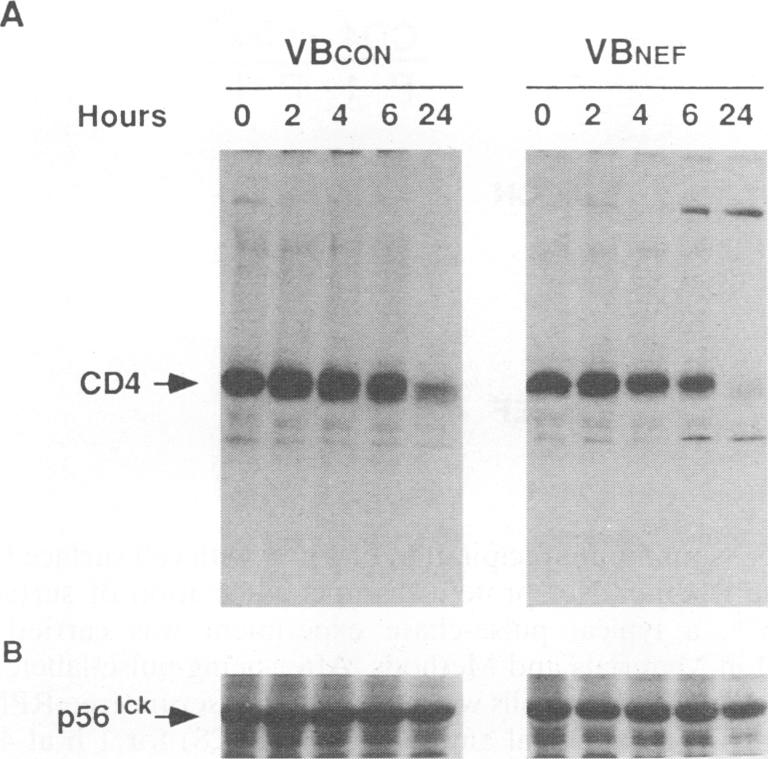
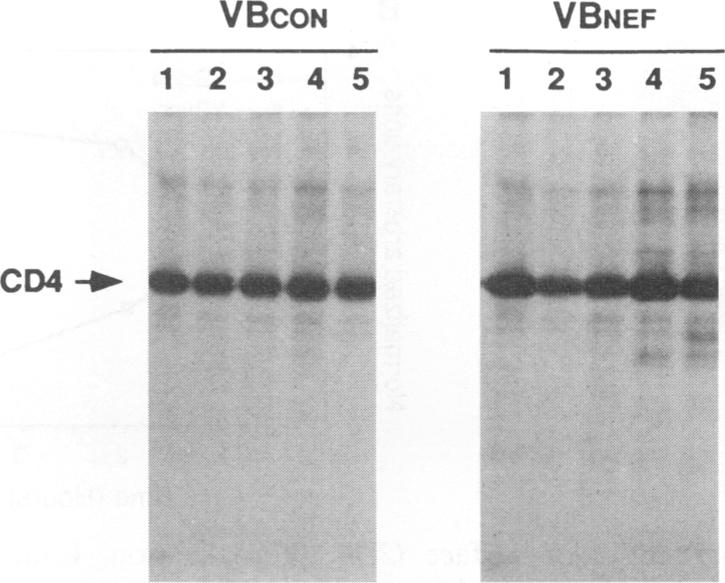
Human immunodeficiency virus type 1 (HIV-1) Nef is a myristylated protein with a relative molecular mass of 27 kDa, is localized to the cytoplasmic surfaces of cellular membranes, and has been reported to down-modulate CD4 in human T cells. To understand the mechanism of HIV-1 Nef-mediated down-modulation of cell surface CD4, we expressed Nef protein in human T-cell line VB. Expression of HIV-1 Nef protein down-modulated surface CD4 molecules. In pulse-chase experiments, CD4 molecules in Nef-expressing cells were synthesized at normal levels. However, the bulk of newly synthesized CD4 protein was degraded with a half-life of approximately 6 h, compared with the 24-h half-life in control cells. This Nef-induced acceleration of CD4 turnover was inhibited by lysosomotropic agents NH4Cl and chloroquine as well as by the protease inhibitor leupeptin. Surface CD4 biotinylation experiments demonstrated that CD4 molecules in Nef-expressing T cells are transported to the plasma membrane with normal kinetics but are then rapidly internalized. Therefore, HIV-1 Nef-induced down-modulation of CD4 is due to rapid internalization of surface CD4 and subsequent degradation by an acid-dependent process, potentially lysosomal. Additionally, in a Nef-expressing cell, we find accelerated dissociation of the T-cell tyrosine kinase p56lck and CD4 but only after the complex reaches the plasma membrane. This implies that HIV-1 Nef protein might play a role in triggering a series of T-cell activation-like events, which contribute to p56lck dissociation and internalization of surface CD4 molecules.
1型人类免疫缺陷病毒(HIV-1)Nef是一种相对分子质量为27 kDa的肉豆蔻酰化蛋白,定位于细胞膜的细胞质表面,据报道可下调人类T细胞中的CD4。为了了解HIV-1 Nef介导的细胞表面CD4下调机制,我们在人类T细胞系VB中表达了Nef蛋白。HIV-1 Nef蛋白的表达下调了表面CD4分子。在脉冲追踪实验中,表达Nef的细胞中的CD4分子以正常水平合成。然而,与对照细胞中24小时的半衰期相比,新合成的大部分CD4蛋白以约6小时的半衰期被降解。溶酶体促渗剂NH4Cl和氯喹以及蛋白酶抑制剂亮抑酶肽可抑制这种Nef诱导的CD4周转加速。表面CD4生物素化实验表明,表达Nef的T细胞中的CD4分子以正常动力学转运到质膜,但随后迅速内化。因此,HIV-1 Nef诱导的CD4下调是由于表面CD4的快速内化以及随后通过酸依赖性过程(可能是溶酶体)降解。此外,在表达Nef的细胞中,我们发现T细胞酪氨酸激酶p56lck与CD4的解离加速,但仅在复合物到达质膜后。这意味着HIV-1 Nef蛋白可能在引发一系列T细胞活化样事件中起作用,这些事件有助于p56lck解离和表面CD4分子的内化。