Riley G P, Harrall R L, Constant C R, Chard M D, Cawston T E, Hazleman B L
Rheumatology Research Unit, Addenbrooke's Hospital, Cambridge, United Kingdom.
Ann Rheum Dis. 1994 Jun;53(6):359-66. doi: 10.1136/ard.53.6.359.
To analyse the collagen composition of normal adult human supraspinatus tendon and to compare with: (1) a flexor tendon (the common biceps tendon) which is rarely involved in any degenerative pathology; (2) degenerate tendons from patients with chronic rotator cuff tendinitis.
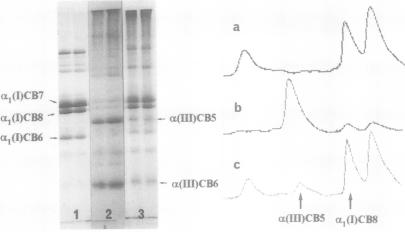
Total collagen content, collagen solubility and collagen type were investigated by hydroxyproline analysis, acetic acid and pepsin digestion, cyanogen bromide peptide analysis, SDS-PAGE and Western blotting.
The collagen content of the normal cadaver supraspinatus tendons (n = 60) was 96.3 micrograms HYPRO/mg dry weight (range 79.3-113.3) and there was no significant change across the age range 11 to 95 years. There was no significant difference from the common biceps tendon [93.3 (13.5) micrograms HYPRO/mg dry weight, n = 24]. Although extremely insoluble in both acetic acid and pepsin, much of the collagen was soluble after cyanogen bromide digestion [mean 47.9% (29.8)]. Seventeen per cent (10/60) of the 'normal' cadaver supraspinatus tendon sample contained more than 5% type III collagen, although none of the common biceps tendons had significant amounts. Degenerate supraspinatus and subscapularis tendons had a reduced collagen content [83.8 (13.9) micrograms/mg dry weight and 76.9 (16.8) micrograms/mg dry wt respectively) and were more soluble in acetic acid, pepsin and cyanogen bromide (p < 0.001). Eighty two per cent (14/17) of supraspinatus tendons and 100% (8/8) of subscapularis tendons from patients with tendinitis contained more than 5% type III collagen.
The changes in collagen composition in rotator cuff tendinitis are consistent with new matrix synthesis, tissue remodelling and wound healing, in an attempt to repair the tendon defect, even in old and degenerate tendons. An increase in type III collagen in some 'normal' cadaver supraspinatus tendons is evidence that changes in collagen synthesis and turnover may precede tendon rupture. These changes may be the result of repeated minor injury and microscopic fibre damage or a consequence of local factors such as reduced vascular perfusion, tissue hypoxia, altered mechanical forces and the influence of cytokines. These collagenous changes may accumulate with age and substantially weaken the tendon structure, predisposing the tendon to rotator cuff tendinitis and eventual tendon rupture.
分析正常成人肩袖上肌腱的胶原蛋白组成,并与以下情况进行比较:(1)很少发生任何退行性病变的屈肌腱(肱二头肌总腱);(2)慢性肩袖肌腱炎患者的退变肌腱。
通过羟脯氨酸分析、乙酸和胃蛋白酶消化、溴化氰肽分析、SDS-PAGE和蛋白质印迹法研究总胶原蛋白含量、胶原蛋白溶解性和胶原蛋白类型。
正常尸体肩袖上肌腱(n = 60)的胶原蛋白含量为96.3微克羟脯氨酸/毫克干重(范围79.3 - 113.3),在11至95岁的年龄范围内无显著变化。与肱二头肌总腱[93.3(13.5)微克羟脯氨酸/毫克干重,n = 24]无显著差异。虽然在乙酸和胃蛋白酶中极难溶解,但大部分胶原蛋白在溴化氰消化后可溶解[平均47.9%(29.8)]。17%(10/60)的“正常”尸体肩袖上肌腱样本含III型胶原蛋白超过5%,而肱二头肌总腱均无显著含量。退变的肩袖上肌腱和肩胛下肌腱胶原蛋白含量降低[分别为83.8(13.9)微克/毫克干重和76.9(16.8)微克/毫克干重],且在乙酸、胃蛋白酶和溴化氰中更易溶解(p < 0.001)。肌腱炎患者的肩袖上肌腱82%(14/17)和肩胛下肌腱100%(8/8)含III型胶原蛋白超过5%。
肩袖肌腱炎中胶原蛋白组成的变化与新基质合成、组织重塑和伤口愈合一致,试图修复肌腱缺陷,即使在陈旧和退变的肌腱中也是如此。一些“正常”尸体肩袖上肌腱中III型胶原蛋白增加表明胶原蛋白合成和周转的变化可能先于肌腱断裂。这些变化可能是反复轻微损伤和微观纤维损伤的结果,或局部因素如血管灌注减少、组织缺氧、机械力改变和细胞因子影响的结果。这些胶原变化可能随年龄积累并显著削弱肌腱结构,使肌腱易患肩袖肌腱炎并最终导致肌腱断裂。