Roth D, Morgan A, Martin H, Jones D, Martens G J, Aitken A, Burgoyne R D
Physiological Laboratory, University of Liverpool, U.K.
Biochem J. 1994 Jul 1;301 ( Pt 1)(Pt 1):305-10. doi: 10.1042/bj3010305.
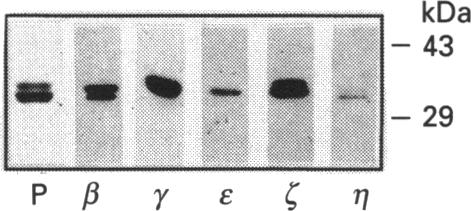
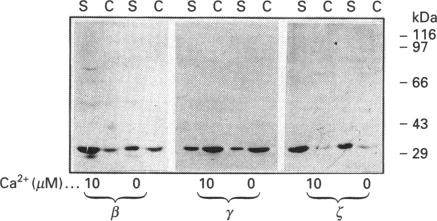
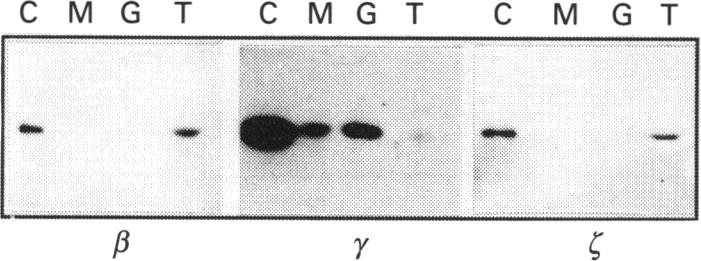
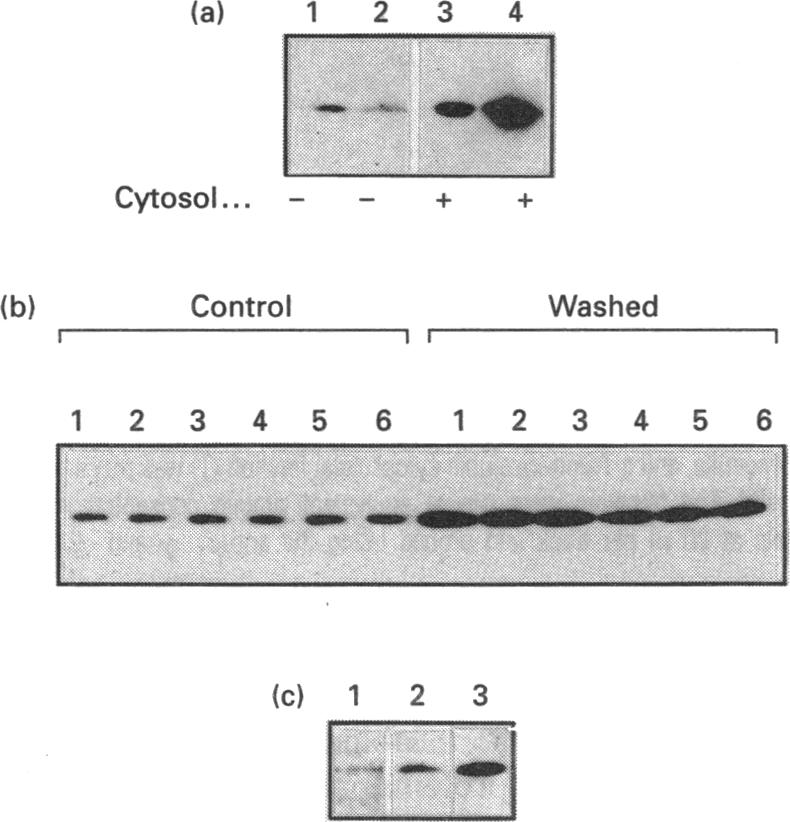
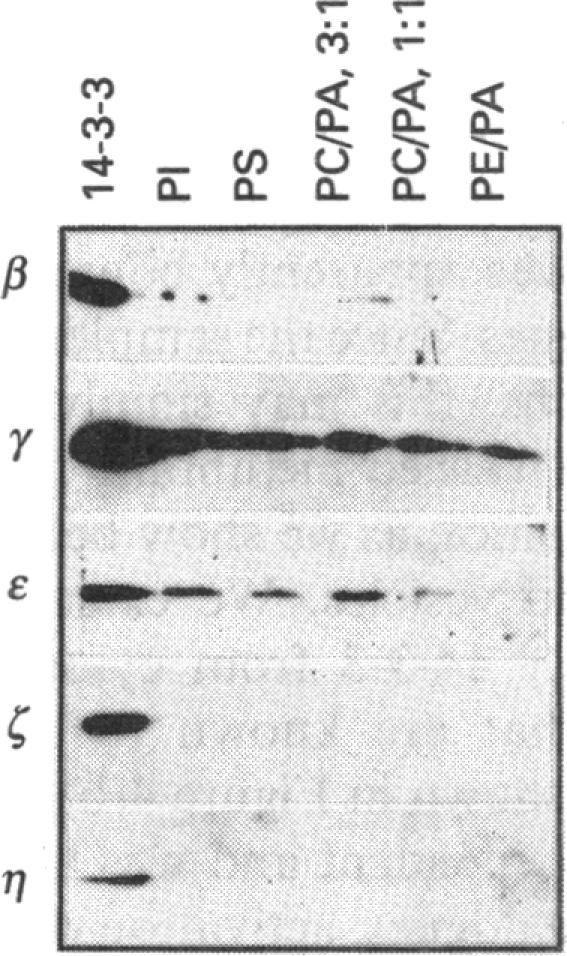
Isoform-specific antisera were used to examine which 14-3-3 isoforms were present in bovine adrenal chromaffin cells. The eta, tau and sigma isoforms were not detectable, and the epsilon isoform was present at only low levels. 14-3-3 isoforms were readily detected with antisera against the beta, gamma and zeta isoforms. The latter isoforms were found to leak from digitonin-permeabilized chromaffin cells, as expected for cytosolic proteins, but a proportion of each isoform was retained. In subcellular fractionation studies isoforms recognized by the beta and zeta antisera were found in the cytosol and Triton-insoluble cytoskeletal fractions, while the gamma isoform was found in cytosol and also in microsomal and chromaffin granule membrane fractions. The gamma 14-3-3 protein associated with granule membranes was partially removed by a high-salt/carbonate wash, and the membranes could bind further gamma from cytosol or from a purified brain 14-3-3 protein mixture. The binding of gamma 14-3-3 was not Ca(2+)-dependent, nor was it affected by phorbol ester, GTP analogues or cyclic AMP. Using pure phospholipid vesicles it was found that gamma and also epsilon 14-3-3 proteins bound directly to phospholipids. Little binding of brain beta, eta or zeta to phospholipid vesicles was detected. Brain 14-3-3 proteins were also able to aggregate phospholipid vesicles. Recombinant 14-3-3 isoforms (tau and the Xenopus protein) were able to stimulate Ca(2+)-dependent exocytosis in digitonin-permeabilized chromaffin cells. The Xenopus proteins lacks part of the extreme N-terminus, indicating that this domain is not essential for function in exocytosis.
使用亚型特异性抗血清来检测牛肾上腺嗜铬细胞中存在哪些14-3-3亚型。未检测到η、τ和σ亚型,ε亚型仅以低水平存在。用针对β、γ和ζ亚型的抗血清很容易检测到14-3-3亚型。正如胞质蛋白所预期的那样,后几种亚型从洋地黄皂苷通透的嗜铬细胞中泄漏出来,但每种亚型都有一部分被保留下来。在亚细胞分级分离研究中,β和ζ抗血清识别的亚型存在于细胞质和不溶于Triton的细胞骨架组分中,而γ亚型存在于细胞质以及微粒体和嗜铬颗粒膜组分中。与颗粒膜相关的γ 14-3-3蛋白可通过高盐/碳酸盐洗涤部分去除,并且这些膜可以结合来自细胞质或纯化脑14-3-3蛋白混合物中的更多γ。γ 14-3-3的结合不依赖于Ca(2+),也不受佛波酯、GTP类似物或环磷酸腺苷的影响。使用纯磷脂囊泡发现,γ以及ε 14-3-3蛋白直接与磷脂结合。未检测到脑β、η或ζ与磷脂囊泡的明显结合。脑14-3-3蛋白也能够使磷脂囊泡聚集。重组14-3-3亚型(τ和非洲爪蟾蛋白)能够刺激洋地黄皂苷通透的嗜铬细胞中依赖Ca(2+)的胞吐作用。非洲爪蟾蛋白缺少部分极端N端,表明该结构域对于胞吐作用的功能不是必需的。