Besansky N J, Powell J R, Caccone A, Hamm D M, Scott J A, Collins F H
Division of Parasitic Diseases, Centers for Disease Control and Prevention, Atlanta, GA 30333.
Proc Natl Acad Sci U S A. 1994 Jul 19;91(15):6885-8. doi: 10.1073/pnas.91.15.6885.
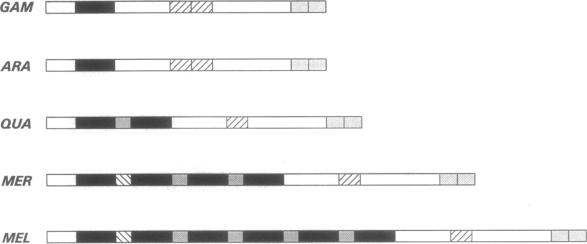
The six Afrotropical species of mosquitoes comprising the Anopheles gambiae complex include the most efficient vectors of malaria in the world as well as a nonvector species. The accepted interpretation of evolutionary relationships among these species is based on chromosomal inversions and suggests that the two principal vectors, A. gambiae and Anopheles arabiensis, are on distant branches of the phylogenetic tree. However, DNA sequence data indicate that these two species are sister taxa and suggest gene flow between them. These results have important implications for malaria control strategies involving the replacement of vector with nonvector populations.
冈比亚按蚊复合体中的六种非洲热带蚊子包括世界上最有效的疟疾传播媒介以及一种非传播媒介物种。对这些物种间进化关系的公认解释基于染色体倒位,并表明两个主要传播媒介,冈比亚按蚊和阿拉伯按蚊,位于系统发育树的遥远分支上。然而,DNA序列数据表明这两个物种是姐妹分类群,并暗示它们之间存在基因流动。这些结果对于涉及用非传播媒介种群替代传播媒介的疟疾控制策略具有重要意义。