Mühlradt P F, Frisch M
Immunology Research Group, Gesellschaft für Biotechnologische Forschung mbH, Braunschweig, Germany.
Infect Immun. 1994 Sep;62(9):3801-7. doi: 10.1128/iai.62.9.3801-3807.1994.
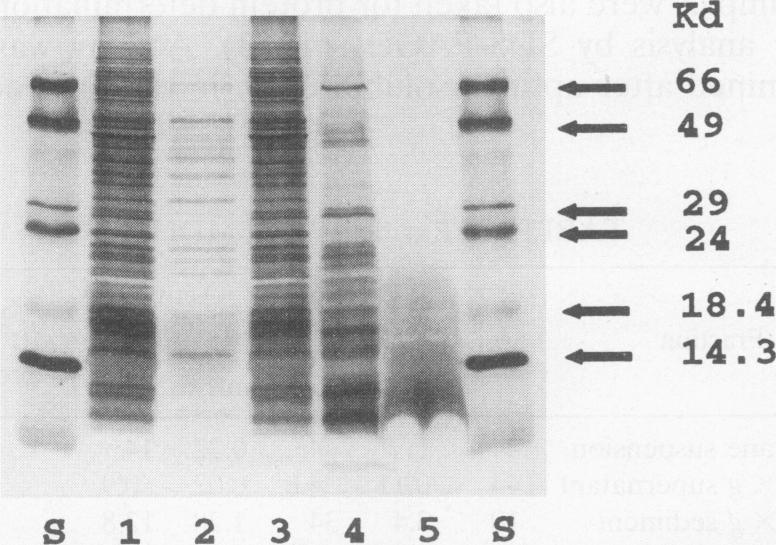
Mycoplasmal products may exert a number of diverse in vitro effects on cells of the immune system. A macrophage-activating substance from Mycoplasma fermentans was described in this laboratory and named mycoplasma-derived high-molecular-weight material (MDHM). Using synthesis of nitric oxide by peritoneal cells from endotoxin low-responder mice as an assay system, MDHM was purified as follows. After freeze-thawing of M. fermentans, MDHM activity was sedimented with the membrane fraction. Membranes were delipidated with chloroform-methanol, and MDHM activity was extracted with octyl glucoside. Coextracted proteins were degraded by proteinase K. MDHM was further purified by reversed-phase high-pressure liquid chromatography and eluted in one major and one minor peak of activity. Neither carbohydrates nor amino acids were found as constituents. MDHM had the following properties: it partitioned into the phenol phase upon phenol-water extraction and into the Triton phase after extraction with Triton X-114. MDHM was not inactivated by either phospholipase A2 or triglyceride lipases. However, mild periodate treatment led to a > 95% loss of activity. Also, alkaline hydrolysis at 25 degrees C completely abolished MDHM activity with a half-life of 2 min. MDHM activity was spread out over a wide molecular weight range upon sodium dodecyl sulfate-polyacrylamide gel electrophoresis of membranes, whereas after proteinase treatment MDHM activity migrated close to the front. These features of MDHM, taken together, speak in favor of an amphiphilic molecule with a lipid moiety carrying fatty acids in ester linkage and a polyol moiety of unknown character. MDHM was active in the nanogram-per-milliliter range, activating macrophages to release nitric oxide, interleukin-6, and tumor necrosis factor.
支原体产物可能对免疫系统细胞产生多种不同的体外效应。本实验室曾描述过一种来自发酵支原体的巨噬细胞激活物质,并将其命名为支原体衍生的高分子量物质(MDHM)。以内毒素低反应小鼠腹腔细胞合成一氧化氮作为检测系统,MDHM按如下方法进行纯化。发酵支原体经冻融后,MDHM活性与膜部分一起沉淀。用氯仿 - 甲醇去除膜中的脂质,并用辛基葡糖苷提取MDHM活性。共提取的蛋白质用蛋白酶K降解。MDHM通过反相高压液相色谱进一步纯化,并在一个主要活性峰和一个次要活性峰中洗脱。未发现碳水化合物和氨基酸作为其成分。MDHM具有以下特性:在酚 - 水萃取时它分配到酚相中,在用Triton X - 114萃取后分配到Triton相中。MDHM既不被磷脂酶A2也不被甘油三酯脂肪酶灭活。然而,轻度高碘酸盐处理导致活性损失> 95%。此外,在25℃下进行碱性水解会使MDHM活性完全丧失,半衰期为2分钟。在对膜进行十二烷基硫酸钠 - 聚丙烯酰胺凝胶电泳时,MDHM活性分布在较宽的分子量范围内,而在蛋白酶处理后,MDHM活性迁移至靠近前沿的位置。综合MDHM的这些特征,表明它是一种两亲性分子,具有通过酯键连接脂肪酸的脂质部分和性质未知的多元醇部分。MDHM在纳克每毫升范围内具有活性,可激活巨噬细胞释放一氧化氮、白细胞介素 - 6和肿瘤坏死因子。