Baba T, Shinke R, Nanmori T
Department of Utilization of Biological Resources, Graduate School of Science and Technology, Kobe University, Japan.
Appl Environ Microbiol. 1994 Jul;60(7):2252-8. doi: 10.1128/aem.60.7.2252-2258.1994.
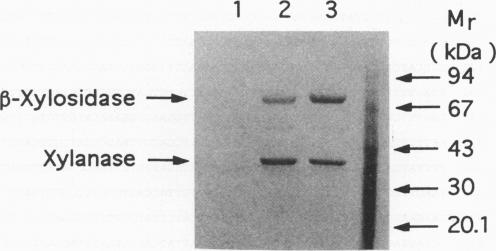
Bacillus stearothermophilus 21 is a gram-positive, facultative thermophilic aerobe that can utilize xylan as a sole source of carbon. We isolated this strain from soil, purified its extracellular xylanase and beta-xylosidase, and analyzed the two-step degradation of xylan by these enzymes (T. Nanmori, T. Watanabe, R. Shinke, A. Kohno, and Y. Kawamura, J. Bacteriol. 172:6669-6672, 1990). An Escherichia coli transformant carrying a 4.2-kbp chromosomal segment of this bacterium as a recombinant plasmid was isolated. It excreted active beta-xylosidase and xylanase into the culture medium. The plasmid was introduced into UV-sensitive E. coli CSR603, and its protein products were analyzed by the maxicell method. Proteins harboring beta-xylosidase and xylanase activities were identified, and their molecular masses were estimated by sodium dodecyl sulfate-polyarylamide gel electrophoresis to be 75 and 40 kDa, respectively. The values were identical to those of proteins prepared from cells of B. stearothermophilus 21. The genes for both enzymes were encoded in a 3.4-kbp PstI fragment derived from the 4.2-kbp chromosomal segment. The nucleotide sequence of the 4.2-kbp segment was accordingly determined. The beta-xylosidase gene (xylA) is located upstream of the xylanase gene (xynA) with a possible promoter and a Shine-Dalgarno sequence. The latter gene is preceded by two possible promoters and a Shine-Dalgarno sequence that are located within the 3'-terminal coding region of the former. The two genes thus appear to be, at least partly, expressed independently, which was experimentally confirmed in E. coli by deletion analysis.(ABSTRACT TRUNCATED AT 250 WORDS)
嗜热脂肪芽孢杆菌21是一种革兰氏阳性兼性嗜热需氧菌,能够利用木聚糖作为唯一碳源。我们从土壤中分离出该菌株,纯化了其胞外木聚糖酶和β-木糖苷酶,并分析了这些酶对木聚糖的两步降解过程(T. 南森、T. 渡边、R. 新科、A. 小野和Y. 川村,《细菌学杂志》172:6669 - 6672,1990年)。分离出了携带该细菌4.2千碱基对染色体片段作为重组质粒的大肠杆菌转化体。它将活性β-木糖苷酶和木聚糖酶分泌到培养基中。将该质粒导入对紫外线敏感的大肠杆菌CSR603,并通过最大细胞法分析其蛋白质产物。鉴定出了具有β-木糖苷酶和木聚糖酶活性的蛋白质,通过十二烷基硫酸钠 - 聚丙烯酰胺凝胶电泳估计它们的分子量分别为75和40千道尔顿。这些值与从嗜热脂肪芽孢杆菌21细胞制备的蛋白质的值相同。两种酶的基因都编码在源自4.2千碱基对染色体片段的3.4千碱基对PstI片段中。据此确定了4.2千碱基对片段的核苷酸序列。β-木糖苷酶基因(xylA)位于木聚糖酶基因(xynA)的上游,带有一个可能的启动子和一个Shine-Dalgarno序列。后一个基因前面有两个可能的启动子和一个Shine-Dalgarno序列,它们位于前一个基因的3'末端编码区内。因此,这两个基因似乎至少部分是独立表达的,这一点在大肠杆菌中通过缺失分析得到了实验证实。(摘要截断于250字)