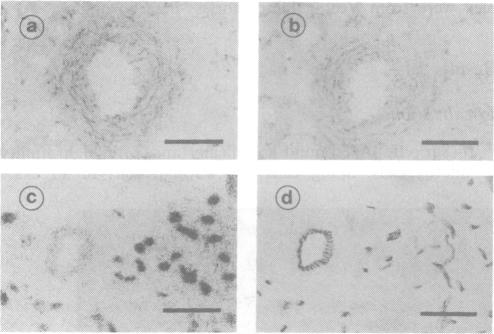
Angiotensin II (AII) reduces blood flow, modulates vascular remodelling and is a growth factor. Human inflammatory arthritides are characterized by synovial hypoperfusion, hypoxia and proliferation. We aimed to localize and characterize receptors for AII in human synovium. 2. We used quantitative in vitro receptor autoradiography with [125I]-(Sar1, Ile8)AII and [125I]-AII on human synovium from patients with chondromalacia patellae, osteoarthritis and rheumatoid arthritis. 3. [125I]-(Sar1, Ile8)AII and [125I]-AII bound to similar sites on synovial blood vessels, lining cells and stroma. Binding to microvessels (< 100 microns diameter) was more dense than to arteriolar media, and vascular binding was more dense than that to lining cells and stroma. 4. Microvessels and arterioles which displayed angiotensin converting enzyme-like immunoreactivity also displayed specific binding of [125I]-(Sar1, Ile8)AII. 5. Specific binding of [125I]-(Sar1, Ile8)AII to each structure was completely inhibited by 10 microM dithiothreitol and was inhibited by unlabelled ligands with the rank order of potency (Sar1, Ile8)AII > AII > losartan = SKF108566 > PD123319 indicating an AT1 subclass of angiotensin receptor. 6. GTP gamma S (1 microM) abolished specific binding of [125I]-AII and abolished the high affinity component of the binding inhibition curve for AII against [125I]-(Sar1, Ile8)AII, indicating G protein coupling. 7. The distribution of [125I]-(Sar1, Ile8)AII binding sites was similar in all disease groups and no significant differences in binding densities, affinities or specificities were observed between disease groups. 8. Locally generated AII may act on synovial AT1 receptors to modulate synovial perfusion and growth. Specific AT1 receptor antagonists should help elucidate the role of angiotensins in human arthritis.