Gershon A A, Sherman D L, Zhu Z, Gabel C A, Ambron R T, Gershon M D
Department of Pediatrics, Columbia University College of Physicians and Surgeons, New York, New York 10032.
J Virol. 1994 Oct;68(10):6372-90. doi: 10.1128/JVI.68.10.6372-6390.1994.
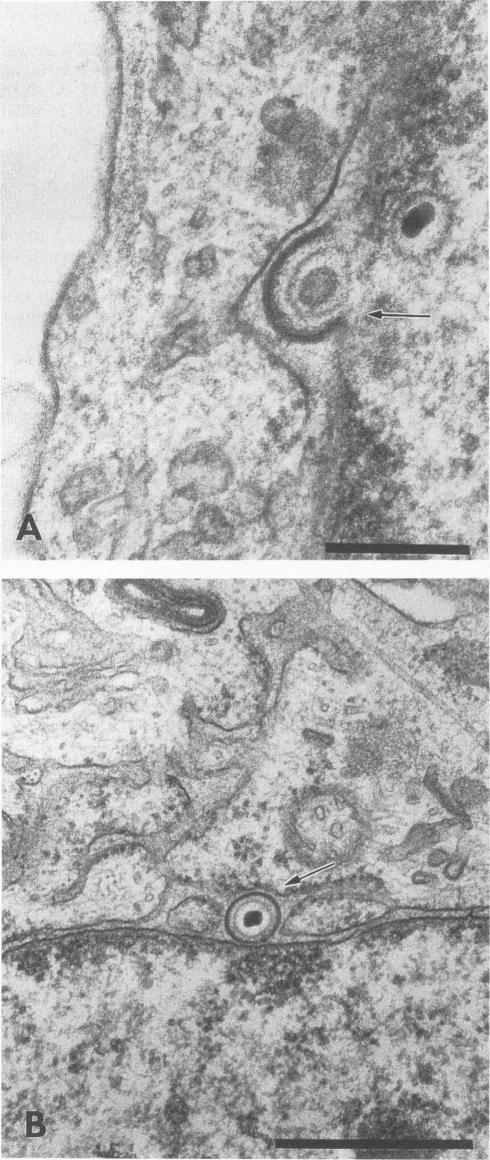
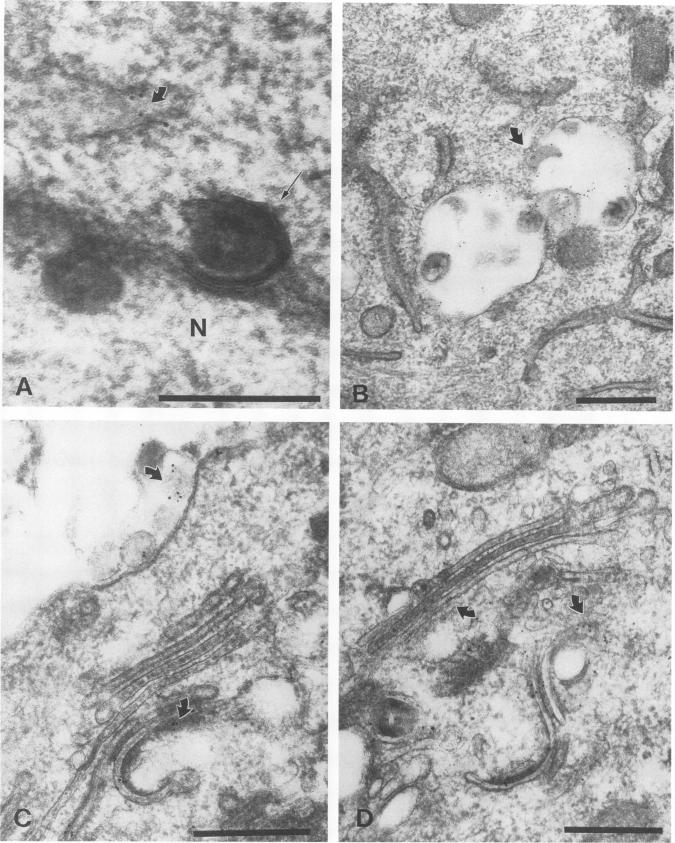
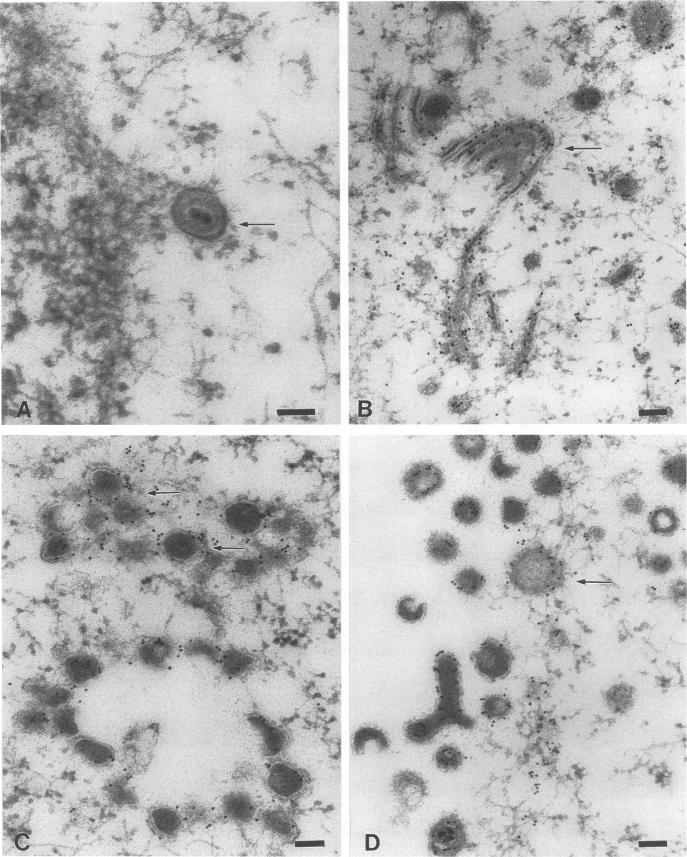
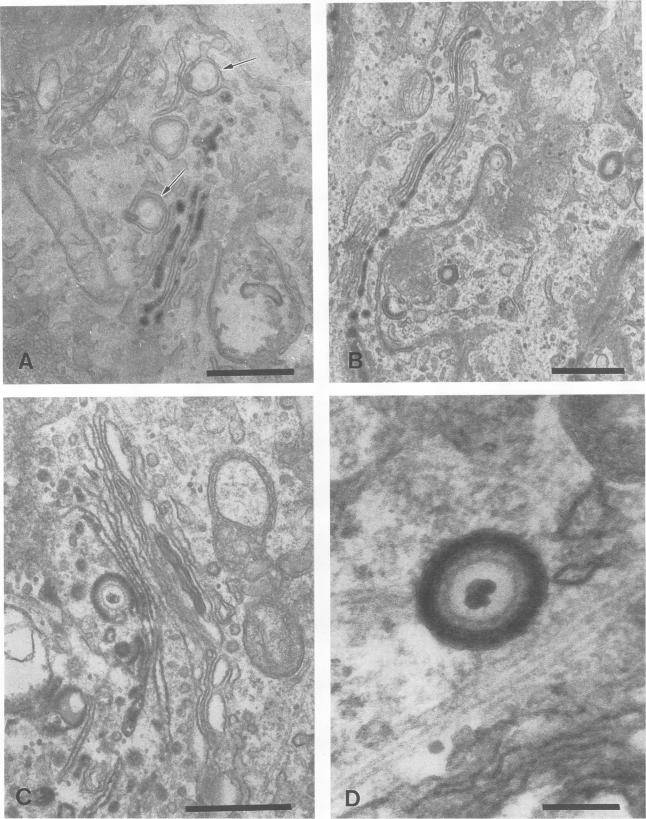
The maturation and envelopment of varicella-zoster virus (VZV) was studied in infected human embryonic lung fibroblasts. Transmission electron microscopy confirmed that nucleocapsids acquire an envelope from the inner nuclear membrane as they enter the perinuclear-cisterna-rough endoplasmic reticulum (RER). Tegument is not detectable in these virions; moreover, in contrast to the mature VZV envelope, the envelope of VZV in the RER is not radioautographically labeled in pulse-chase experiments with [3H]mannose, and it lacks gpI immunoreactivity and complex oligosaccharides. This primary envelope fuses with the RER membrane (detected in cells incubated at 20 degrees C), thereby releasing nucleocapsids to the cytosol. Viral glycoproteins, traced by transmission electron microscopy radioautography in pulse-chase experiments with [3H]mannose, are transported to the trans-Golgi network (TGN) by a pathway that runs from the RER through an intermediate compartment and the Golgi stack. At later chase intervals, [3H]mannose labeling becomes associated with enveloped virions in post-Golgi locations (prelysosomes and plasma membrane). Nucleocapsids appear to be enveloped by wrapping in specialized cisternae, identified as the TGN with specific markers. Tegument-like material adheres to the cytosolic face of the concave surface of TGN sacs; nucleocapsids adhere to this protein, which is thus trapped between the nucleocapsid and the TGN-derived membrane that wraps around it. Experiments with brefeldin A suggest that tegument may bind to the cytosolic tails of viral glycoproteins. Fusion and fission convert the TGN-derived wrapping sacs into an inner enveloped virion and an outer transport vesicle that carries newly enveloped virions to cytoplasmic vacuoles. These vacuoles are acidic and were identified as prelysosomes. It is postulated that secreted virions are partially degraded by their exposure to the prelysosomal internal milieu and rendered noninfectious. This process explains the cell-associated nature of VZV in vitro; however, the mechanism by which the virus escapes diversion from the secretory pathway to the lysosomal pathway in vivo remains to be determined.
在感染的人胚肺成纤维细胞中研究了水痘带状疱疹病毒(VZV)的成熟和包膜化过程。透射电子显微镜证实,核衣壳在进入核周池 - 粗面内质网(RER)时从内核膜获得包膜。在这些病毒粒子中未检测到被膜;此外,与成熟的VZV包膜相比,在RER中的VZV包膜在[3H]甘露糖脉冲追踪实验中没有放射性自显影标记,并且缺乏gpI免疫反应性和复合寡糖。这种初级包膜与RER膜融合(在20℃孵育的细胞中检测到),从而将核衣壳释放到细胞质中。在[3H]甘露糖脉冲追踪实验中,通过透射电子显微镜放射自显影追踪的病毒糖蛋白通过从RER经中间区室和高尔基体堆叠的途径转运到反式高尔基体网络(TGN)。在随后的追踪间隔中,[3H]甘露糖标记与高尔基体后位置(前溶酶体和质膜)中的包膜病毒粒子相关。核衣壳似乎通过包裹在特化的池(用特定标记物鉴定为TGN)中而被包膜。被膜样物质附着在TGN囊泡凹面的胞质面上;核衣壳附着在这种蛋白质上,因此被困在核衣壳和围绕它的TGN衍生膜之间。用布雷菲德菌素A进行的实验表明,被膜可能与病毒糖蛋白的胞质尾部结合。融合和裂变将TGN衍生的包裹囊泡转化为内部包膜病毒粒子和外部运输囊泡,后者将新包膜的病毒粒子运送到细胞质空泡。这些空泡呈酸性,被鉴定为前溶酶体。据推测,分泌的病毒粒子因暴露于前溶酶体内部环境而部分降解并失去感染性。这一过程解释了VZV在体外的细胞相关性;然而,病毒在体内如何逃避从分泌途径转向溶酶体途径的机制仍有待确定。