Su Y A, Trent J M, Guan X Y, Meltzer P S
Laboratory of Cancer Genetics, National Center for Human Genome Research, National Institutes of Health, Bethesda, MD 20892.
Proc Natl Acad Sci U S A. 1994 Sep 13;91(19):9121-5. doi: 10.1073/pnas.91.19.9121.
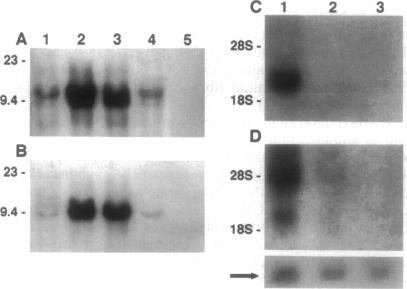
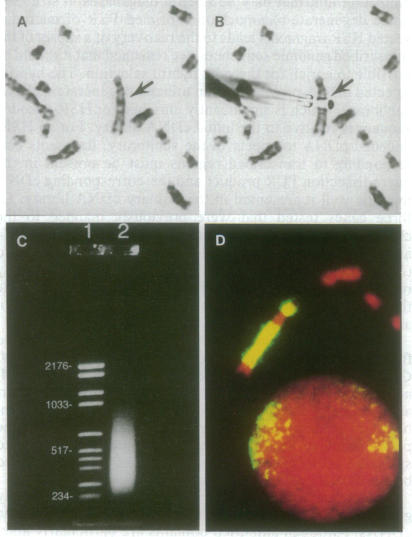
Identification of genes involved in recurring chromosome rearrangements has provided significant insight into the molecular basis of malignancy. We describe here a strategy combining chromosome microdissection and hybrid selection for the direct isolation of chromosome region-specific genes. We modeled this strategy by using sequences recovered from the microdissection of a homogeneously staining region to allow isolation of genes that were overexpressed and present at high copy number within the homogeneously staining region, including the direct isolation of two genes encoded within a 12q homogeneously staining region found in the osteosarcoma cell line OsA-CL. Although first applied to amplified genes, this strategy should be applicable to the isolation of cDNAs from any chromosomal region.
对参与反复染色体重排的基因进行鉴定,为深入了解恶性肿瘤的分子基础提供了重要线索。我们在此描述一种将染色体显微切割和杂交筛选相结合的策略,用于直接分离染色体区域特异性基因。我们通过使用从均匀染色区显微切割回收的序列对该策略进行建模,以分离在均匀染色区内高表达且以高拷贝数存在的基因,包括直接分离在骨肉瘤细胞系OsA-CL中发现的12q均匀染色区内编码的两个基因。尽管该策略最初应用于扩增基因,但它应该适用于从任何染色体区域分离cDNA。