Moore W S, Vescera C L
UCLA Center for the Health Sciences Department of Surgery 90024-6904.
Ann Surg. 1994 Sep;220(3):331-9; discussion 339-41. doi: 10.1097/00000658-199409000-00009.
The authors describe the initial clinical experience with a new device, approved by the FDA for investigation, for repair of abdominal aortic aneurysm by transfemoral endovascular insertion of an aortic graft.
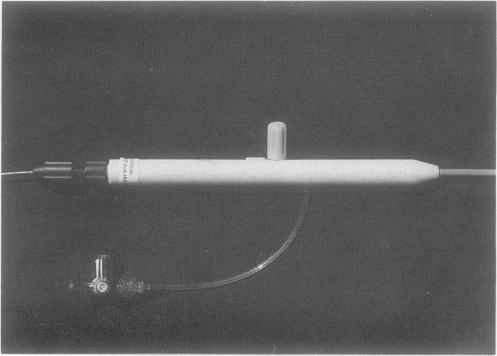
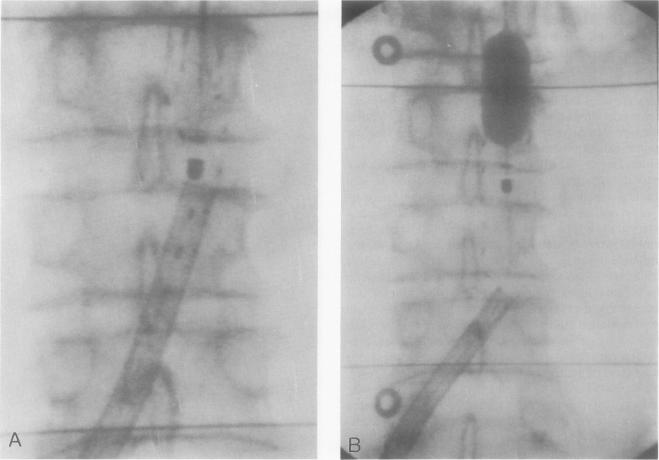
Sixty-nine patients with abdominal aortic aneurysms were screened, and ten were found to be suitable for endovascular grafting. Repair was done in the operating room using general anesthesia. One femoral artery was surgically exposed, and the device, containing a premeasured graft with proximal and distal self-expanding fixation devices, was inserted with fluoroscopic control through an open arteriotomy.
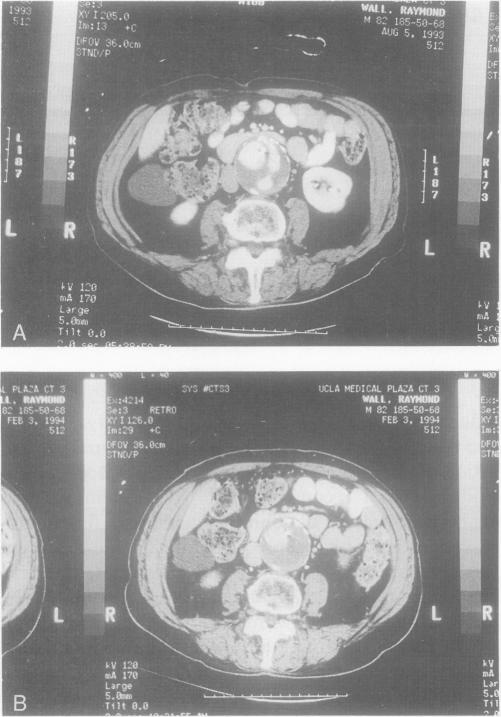
Eight of ten patients underwent successful graft placement, and two patients required conversion to an open repair. On follow-up, six of eight patients who underwent graft placement functioned normally, with documented aneurysm thrombosis. Two patients who underwent graft placement functioned normally, with contrast computed tomography evidence of incomplete aneurysm thrombosis, but without further expansion.
Transfemoral repair is safe and appears to be effective. Phase II study currently is appropriate, with need for long-term follow-up.
作者描述了一种经美国食品药品监督管理局(FDA)批准用于研究的新装置的初步临床经验,该装置通过经股动脉血管内插入主动脉移植物来修复腹主动脉瘤。
对69例腹主动脉瘤患者进行筛查,发现10例适合血管内移植。在手术室采用全身麻醉进行修复。手术暴露一条股动脉,在透视控制下通过开放动脉切开术插入该装置,该装置包含一个预先测量好的带有近端和远端自膨胀固定装置的移植物。
10例患者中有8例成功植入移植物,2例患者需要转为开放修复。随访时,8例接受移植物植入的患者中有6例功能正常,有记录显示动脉瘤血栓形成。2例接受移植物植入的患者功能正常,对比计算机断层扫描显示动脉瘤血栓形成不完全,但无进一步扩大。
经股动脉修复是安全的,且似乎有效。目前进行II期研究是合适的,需要长期随访。